Africa
DR Congo Secures Duty-Free Access to China, Strengthening Mining Competitiveness
The Democratic Republic of Congo has moved to deepen its economic engagement with China, formalising a new phase of cooperation centred on geology and mineral resources, as Kinshasa seeks to extract greater value from its vast natural wealth.
During a visit to Beijing on March 26, 2026, Congolese officials signed a memorandum of understanding with China’s Ministry of Natural Resources, led by Minister Guan Zhi’ou. The agreement sets out a structured framework for collaboration, underpinned by regular institutional dialogue, guarantees on investment protection and a commitment to operate within Congo’s legal and regulatory regime.
Crucially, the deal places renewed emphasis on local value creation, with both sides endorsing the development of domestic processing capacity rather than the continued export of raw materials. This reflects a broader shift in Congolese policy aimed at capturing a larger share of the mining value chain.
The agreement comes with immediate commercial incentives. From May 1, 2026, Congolese exports to China will benefit from duty-free access, a move expected to improve the competitiveness of the country’s mining sector and support near-term growth. Officials on both sides have also committed to establishing a joint monitoring mechanism designed to oversee implementation, ensure regulatory compliance and provide a stable environment for investors.
Particular attention is being directed towards large-scale industrial projects, notably the Grande Orientale Iron Mines (MIFOR). The project, which has drawn significant interest from Chinese partners, is expected to begin with an annual output of 50m tonnes of iron, with ambitions to scale up to 300m tonnes over time. Initial investment is estimated at $28.9bn, positioning it among the most capital-intensive mining developments on the continent.
The strengthening of ties with Beijing comes at a moment of intensifying geopolitical competition over critical minerals, with Kinshasa increasingly leveraging its resource base to negotiate partnerships on more favourable terms. Congolese officials maintain that diversified engagement — including with China and Western partners — remains central to their strategy.
Looking ahead, the Congolese minister has been invited to participate in the International Forum of Ministers of Mines in September, where a joint intervention with his Chinese counterpart is under consideration, signalling continued high-level coordination between the two countries.
The Democratic Republic of Congo has moved to deepen its economic engagement with China, formalising a new phase of cooperation centred on geology and mineral resources, as Kinshasa seeks to extract greater value from its vast natural wealth.
During a visit to Beijing on March 26, 2026, Congolese officials signed a memorandum of understanding with China’s Ministry of Natural Resources, led by Minister Guan Zhi’ou. The agreement sets out a structured framework for collaboration, underpinned by regular institutional dialogue, guarantees on investment protection and a commitment to operate within Congo’s legal and regulatory regime.
Crucially, the deal places renewed emphasis on local value creation, with both sides endorsing the development of domestic processing capacity rather than the continued export of raw materials. This reflects a broader shift in Congolese policy aimed at capturing a larger share of the mining value chain.
The agreement comes with immediate commercial incentives. From May 1, 2026, Congolese exports to China will benefit from duty-free access, a move expected to improve the competitiveness of the country’s mining sector and support near-term growth. Officials on both sides have also committed to establishing a joint monitoring mechanism designed to oversee implementation, ensure regulatory compliance and provide a stable environment for investors.

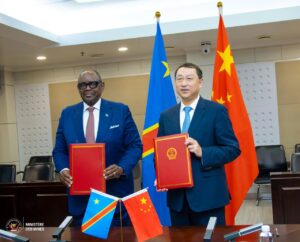
March 26th in Beijing-DR Congo’s Minister Louis Watum and China’s Minister of Natural Resources, Guan Zhi’ou, signing MoU.
Particular attention is being directed towards large-scale industrial projects, notably the Grande Orientale Iron Mines (MIFOR). The project, which has drawn significant interest from Chinese partners, is expected to begin with an annual output of 50m tonnes of iron, with ambitions to scale up to 300m tonnes over time. Initial investment is estimated at $28.9bn, positioning it among the most capital-intensive mining developments on the continent.
The strengthening of ties with Beijing comes at a moment of intensifying geopolitical competition over critical minerals, with Kinshasa increasingly leveraging its resource base to negotiate partnerships on more favourable terms. Congolese officials maintain that diversified engagement — including with China and Western partners — remains central to their strategy.
Looking ahead, the Congolese minister has been invited to participate in the International Forum of Ministers of Mines in September, where a joint intervention with his Chinese counterpart is under consideration, signalling continued high-level coordination between the two countries.