
Africa
Aliko Dangote Warns Middle East Tensions Could Trigger Inflation Surge Across Africa






Africa
Rwanda-DR Congo Tensions Over DRC First Lady Incident
The First Lady of the Democratic Republic of the Congo, Denise Nyakéru Tshisekedi, narrowly avoided what Congolese officials described as a possible security breach at her Washington hotel while she was attending the First Ladies Summit of the Fostering the Future Together Coalition, an initiative linked to former U.S. First Lady Melania Trump. The summit brings together global advocates on women’s and children’s issues.
According to the X’s post from the office of Dr Van Batten‑Montague‑York, L.C., at around 4:51 p.m. local time on Tuesday, initial reports were received suggesting a possible security incident involving the DRC’s First Lady. Preliminary information released and received to his cabinet alleges that individuals identified by security personnel as Rwandan nationals attempted an unlawful and hostile breach of the First Lady’s hotel room. Rapid intervention by her security team prevented what could have been a serious escalation, though details remain unclear. The suspects escaped the scene, with some accounts suggesting they fled in a vehicle believed to have official links to the Government of Rwanda.
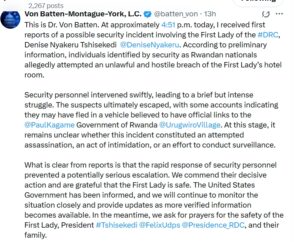
X’s post from Dr Van Batten‑Montague‑York, L.C
However, the nature of the incident has become a flashpoint in an already tense diplomatic context between Kinshasa and Kigali. A statement from the Rwandan Embassy in Washington strongly rejected Congolese claims, denouncing what it called “gross misrepresentation” of the events and accusing the DRC’s Minister of Information of dishonesty in recounting the episode. The Rwandan statement argued that the individual involved was part of a Rwandan VIP security detail at the same hotel and that any encounter with Congolese security was unintentional and occurred in a common area. According to Kigali’s version, the situation was resolved without escalation and the Rwandan team subsequently relocated to another hotel.
DRC government spokesman and Minister of Information, Patrick Muyaya, stated publicly that no individuals had yet been identified in connection with the incident.
The incident comes against a backdrop of enduring friction between the DRC and Rwanda, rooted in longstanding political, security and historical disputes. Relations between the two capitals have been strained particularly over accusations surrounding support for armed groups M23/AFC- and broader regional tensions.
For now, Washington’s role in hosting both the peace initiatives and this diplomatic row highlights the delicate interplay of security, diplomacy and regional politics in the Great Lakes Africa. The true motives behind the hotel incident — whether surveillance, intimidation, or a misinterpreted encounter — remain a matter of international scrutiny.
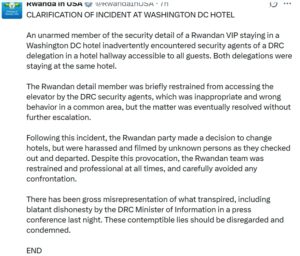
It remains unclear whether this was an attempted assassination, intimidation, or surveillance. What is certain is that the First Lady’s security team acted swiftly to prevent a potentially serious incident.
Africa
Nigeria 2027: Ambode vs Muri-Okunola — Lagos Power Struggle Highlights Bola Tinubu’s Firm Hold on Succession
In Lagos, the language of politics is often coded long before it is declared. Alliances are tested in private, loyalties signalled in public appearances, and candidacies hinted at through carefully crafted messages of “service”. By the time voters are called to the polls, much of the real contest has already taken shape.
As the 2027 governorship race begins to crystallise, familiar patterns are re-emerging—though this time with unusual سرعت. A directive by Nigeria’s president, Bola Tinubu, requiring political appointees seeking elective office to resign by 31 March, has injected urgency into what is typically a slow, deliberate process. While framed as a matter of administrative clarity, the move has also been interpreted by analysts as an early effort to define the field ahead of party primaries.

Akinwunmi Ambode, former governor of Lagos State (left), and Hakeem Muri-Okunola, principal secretary to Bola Tinubu (right). © Rights reserved (montage: JAMG). Source: The Africa Report
Two figures have quickly come into focus: Akinwunmi Ambode and Tayo Muri-Okunola.
Ambode’s potential return carries echoes of past tensions within the state’s political establishment. His single term in office ended after he failed to secure his party’s nomination for re-election—an episode widely seen as reflecting internal disagreements rather than electoral defeat. His reappearance in the early permutations of the 2027 race is likely to revive questions about how power is negotiated within Lagos’ ruling structures, and whether political comebacks are determined as much by reconciliation as by ambition.
Muri-Okunola, by contrast, is viewed as a figure closely aligned with the continuity of the current system. Having operated within the upper tiers of Lagos governance, his profile reflects a different kind of political capital—one rooted in proximity to decision-making circles and long-standing institutional relationships. Supporters argue this experience positions him well for leadership; critics suggest it underscores the enduring influence of established networks.
The broader question is less about the individuals than about the nature of the contest itself. Lagos, Nigeria’s economic hub, has long been characterised by a highly structured political environment in which succession is carefully managed. Though competitive elections are held, the process leading up to them is often decisive.
Tinubu, a central figure in the state’s political evolution over the past two decades, remains widely regarded as influential in shaping outcomes. His recent directive has reinforced that perception, signalling both an assertion of authority and a desire to bring clarity to an emerging field of contenders.
Whether the 2027 race will follow a familiar script or open space for a more unpredictable contest remains to be seen. For now, the early manoeuvring suggests a system still defined by negotiation as much as by nomination.
As attention turns to party primaries and shifting alliances, the Lagos governorship race is once again offering a window into the mechanics of power in Nigeria—where the most consequential decisions are often made long before election day.
Africa
What was Étienne Davignon’s Role in Patrice Lumumba’s Death?
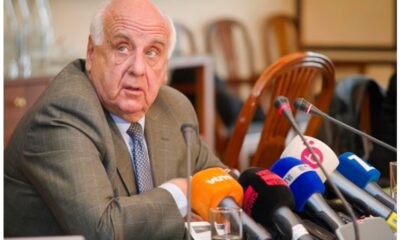
Former top diplomat and European Commissioner Etienne Davignon, 93, has been ordered by the Brussels appeal court to appear in court over his alleged involvement in the assassination of Patrice Lumumba, the first Prime Minister of independent Congo, who was killed in 1961. Davignon still has the right to appeal the decision.
Davignon is the only surviving individual among the Belgians accused by Lumumba’s family of complicity in the murder. In 2002, a Belgian parliamentary investigation concluded that Belgium bore “moral responsibility” for Lumumba’s death.
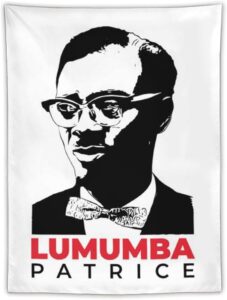
The judicial process has been slow. Lumumba’s family officially filed their war crimes lawsuit in 2011, but it took more than ten years for the courts to complete the investigation. The family believes the government deliberately delayed the process to allow suspects to die before facing justice. Of the eleven Belgians originally accused in 2011, Étienne Davignon is the only one still alive to appear before a judge.
The case itself had long been shrouded in secrecy. Following Lumumba’s assassination, his body was dismembered and dissolved in acid to destroy evidence. For decades, Belgium appeared to consider the case closed, and those involved lived quiet, wealthy lives. It was only after the publication of Ludo de Witte’s investigative book that renewed attention led to a government inquiry in 2000.
At the time of Lumumba’s capture, Davignon was just 28 and serving as a junior diplomat in Belgium’s Congo unit under Foreign Minister Pierre Wigny. Prosecutors allege that he participated in unlawful detention and transfer, deprived Lumumba of the right to a fair trial, and subjected him to humiliating and degrading treatment. He is also implicated in the deaths of two of Lumumba’s political allies, Maurice Mpolo and Joseph Okito, who were executed alongside him.
Davignon later led a highly influential life. He became the first head of the International Energy Agency, served as Vice-President of the European Commission, chaired a major Belgian holding company, and maintained close ties with the Belgian royal family. His wealth and social status helped him avoid scrutiny for much of his life.
He was not present in court on Tuesday, and his lawyer declined to comment. This trial marks a significant moment in Belgium’s reckoning with its colonial history and the role of its officials in one of Africa’s most consequential political assassinations.


Rwanda-DR Congo Tensions Over DRC First Lady Incident

Nigeria 2027: Ambode vs Muri-Okunola — Lagos Power Struggle Highlights Bola Tinubu’s Firm Hold on Succession

Aliko Dangote Warns Middle East Tensions Could Trigger Inflation Surge Across Africa

ECOWAS at 50: President Obasanjo Warns of Declining Trust and Growing Divisions at Oxford Forum

Why Are More Black Britons Applying to Oxford University?


