
Africa
Nigeria 2027: Ambode vs Muri-Okunola — Lagos Power Struggle Highlights Bola Tinubu’s Firm Hold on Succession
In Lagos, the language of politics is often coded long before it is declared. Alliances are tested in private, loyalties signalled in public appearances, and candidacies hinted at through carefully crafted messages of “service”. By the time voters are called to the polls, much of the real contest has already taken shape.
As the 2027 governorship race begins to crystallise, familiar patterns are re-emerging—though this time with unusual سرعت. A directive by Nigeria’s president, Bola Tinubu, requiring political appointees seeking elective office to resign by 31 March, has injected urgency into what is typically a slow, deliberate process. While framed as a matter of administrative clarity, the move has also been interpreted by analysts as an early effort to define the field ahead of party primaries.
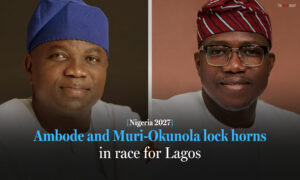
Akinwunmi Ambode, former governor of Lagos State (left), and Hakeem Muri-Okunola, principal secretary to Bola Tinubu (right). © Rights reserved (montage: JAMG). Source: The Africa Report
Two figures have quickly come into focus: Akinwunmi Ambode and Tayo Muri-Okunola.
Ambode’s potential return carries echoes of past tensions within the state’s political establishment. His single term in office ended after he failed to secure his party’s nomination for re-election—an episode widely seen as reflecting internal disagreements rather than electoral defeat. His reappearance in the early permutations of the 2027 race is likely to revive questions about how power is negotiated within Lagos’ ruling structures, and whether political comebacks are determined as much by reconciliation as by ambition.
Muri-Okunola, by contrast, is viewed as a figure closely aligned with the continuity of the current system. Having operated within the upper tiers of Lagos governance, his profile reflects a different kind of political capital—one rooted in proximity to decision-making circles and long-standing institutional relationships. Supporters argue this experience positions him well for leadership; critics suggest it underscores the enduring influence of established networks.
The broader question is less about the individuals than about the nature of the contest itself. Lagos, Nigeria’s economic hub, has long been characterised by a highly structured political environment in which succession is carefully managed. Though competitive elections are held, the process leading up to them is often decisive.
Tinubu, a central figure in the state’s political evolution over the past two decades, remains widely regarded as influential in shaping outcomes. His recent directive has reinforced that perception, signalling both an assertion of authority and a desire to bring clarity to an emerging field of contenders.
Whether the 2027 race will follow a familiar script or open space for a more unpredictable contest remains to be seen. For now, the early manoeuvring suggests a system still defined by negotiation as much as by nomination.
As attention turns to party primaries and shifting alliances, the Lagos governorship race is once again offering a window into the mechanics of power in Nigeria—where the most consequential decisions are often made long before election day.


Africa
If Ebola Is Too Dangerous for America, It Is Too Dangerous for Kenya
Africa
AfCFTA Aims to Unite Africa’s Fragmented Markets Into a Single Trading Bloc
Africa
Republic of Congo’s Denis Sassou Nguesso, 83, Secures Fifth Term in Power
The Republic of Congo’s president, Denis Sassou Nguesso, was sworn in this week after securing a fifth consecutive term, extending a rule that now spans nearly 42 years. Provisional results announced on Tuesday by the officials put his share of the vote at 94.82% on Sunday’s poll — a margin that, while striking, had been widely anticipated.
The official turnout figure, 84.65%, raised immediate questions. State television reported high participation, yet scenes from polling stations in the capital, Brazzaville, suggested a more subdued reality, with many centres registering thin crowds or none at all. The discrepancy has reinforced longstanding doubts about the transparency of the electoral process.
![President Denis Sassou Nguesso casts his vote at a polling station in Brazzaville during the Republic of Congo’s presidential election, 15 March 2026. [Congo Presidency/Handout via Reuters]](https://aukmedia.co.uk/wp-content/uploads/2026/04/DS-300x169.png)
President Denis Sassou Nguesso casts his vote at a polling station in Brazzaville during the Republic of Congo’s presidential election, 15 March 2026. [Congo Presidency/Handout via Reuters]
The election unfolded against the backdrop of an opposition boycott. Two key parties withdrew, alleging unfair conditions, while prominent figures such as General Jean-Marie Michel Mokoko and André Okombi Salissa — both imprisoned for nearly a decade — were absent from the contest. Their exclusion further narrowed an already limited field.
Restrictions in the run-up to the vote added to concerns. Internet access was cut, as has become routine during presidential elections, and movement across Brazzaville was constrained. Human rights groups reported arrests of activists, the suspension of opposition parties and tight monitoring of public gatherings, contributing to what critics describe as a climate of repression.
These dynamics reflect deeper structural patterns. Since returning to power after the 1997 civil war, Sassou Nguesso has consolidated control over state institutions. A 2015 constitutional referendum removed age and term limits, enabling him to extend his tenure and further entrench incumbency.
Yet the political continuity contrasts sharply with the country’s economic fragility. Despite significant oil and mineral wealth, the Republic of Congo remains heavily indebted. According to the World Bank, public debt stands at around 94.5% of gross domestic product, underscoring the persistent gap between resource revenues and broader development outcomes.
The scale of Sassou Nguesso’s victory, combined with the conditions under which it was secured, is likely to deepen scrutiny of both the electoral framework and the prospects for political pluralism. As the new term begins, questions around governance, economic management and eventual succession remain unresolved, even as the contours of power appear largely unchanged.


If Ebola Is Too Dangerous for America, It Is Too Dangerous for Kenya

AfCFTA Aims to Unite Africa’s Fragmented Markets Into a Single Trading Bloc
![President Denis Sassou Nguesso casts his vote at a polling station in Brazzaville during the Republic of Congo’s presidential election, 15 March 2026. [Congo Presidency/Handout via Reuters]](https://aukmedia.co.uk/wp-content/uploads/2026/04/DS-80x80.png)
Republic of Congo’s Denis Sassou Nguesso, 83, Secures Fifth Term in Power

Zia Yusuf from Reform UK Proposes Blocking Visas for Citizens of Countries Pursuing Slavery Reparations

ECOWAS at 50: President Obasanjo Warns of Declining Trust and Growing Divisions at Oxford Forum


