
Africa
From Guinea Conakry to Global Stage: Diene Keita Leads UNFPA Forward.
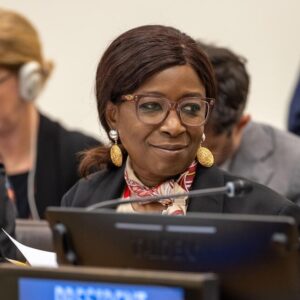
Diene Keita: Guinea’s Trailblazing Diplomat Takes the Helm at UNFPA
When the United Nations Secretary General confirmed Diene Keita as the new Executive Director of the UN Population Fund (UNFPA) on 28 August, it marked another milestone for African leadership within the UN system. Keita, who had been serving in an acting capacity since mid-July, succeeds Natalia Kanem at a time when reproductive rights, demographic pressures and gender equality are at the centre of global debates.
Her appointment places her among a small but growing circle of Africans at the helm of UN institutions, including Tedros Adhanom Ghebreyesus, the World Health Organisation’s Director General. For advocates of a more representative United Nations, Keita’s rise is a sign of progress, bringing African perspectives and priorities into the heart of global decision-making.
Keita’s UN career stretches back more than three decades. She joined the UN Development Programme in 1990 and moved to UNFPA in 2006, taking on some of the organisation’s most challenging country portfolios.
From Nigeria to the Democratic Republic of Congo, she has been at the frontline of efforts to expand access to reproductive healthcare and strengthen women’s rights in fragile settings.
Her tenure as UN resident coordinator in Mauritania and Benin added another layer of leadership, overseeing cross-agency strategies on development and humanitarian response.
But her career has not been confined to the UN system. In 2018, Keita was appointed Guinea’s (Conakry) Minister for Cooperation and African Integration, a cabinet position that placed her at the intersection of diplomacy, trade and regional development.
That blend of international and national-level experience is seen as crucial for steering an agency whose mission is often politically sensitive, spanning issues from family planning to tackling gender-based violence.
Her academic credentials are equally impressive. A Sorbonne-trained lawyer with a doctorate in law, Keita also holds advanced qualifications in economics and international relations. Fluent in English, French and Italian, she has been decorated with national honours in Mauritania and Benin for her public service.
At UNFPA, she faces formidable challenges. The agency continues to push for universal access to sexual and reproductive health services at a time when funding is under strain and women’s rights are facing renewed pushback in several parts of the world. Demographic shifts, including Africa’s fast-growing youth population, add urgency to the task.
Keita has consistently framed her work around empowerment and inclusion. Advocates see in her appointment an opportunity to reinvigorate UNFPA’s mandate with fresh energy and an African perspective. As she takes up the post, she joins a new generation of African leaders at the UN whose influence is shaping global health, development and human rights at a critical moment.





Africa
If Ebola Is Too Dangerous for America, It Is Too Dangerous for Kenya
Africa
AfCFTA Aims to Unite Africa’s Fragmented Markets Into a Single Trading Bloc
Africa
Republic of Congo’s Denis Sassou Nguesso, 83, Secures Fifth Term in Power
The Republic of Congo’s president, Denis Sassou Nguesso, was sworn in this week after securing a fifth consecutive term, extending a rule that now spans nearly 42 years. Provisional results announced on Tuesday by the officials put his share of the vote at 94.82% on Sunday’s poll — a margin that, while striking, had been widely anticipated.
The official turnout figure, 84.65%, raised immediate questions. State television reported high participation, yet scenes from polling stations in the capital, Brazzaville, suggested a more subdued reality, with many centres registering thin crowds or none at all. The discrepancy has reinforced longstanding doubts about the transparency of the electoral process.
![President Denis Sassou Nguesso casts his vote at a polling station in Brazzaville during the Republic of Congo’s presidential election, 15 March 2026. [Congo Presidency/Handout via Reuters]](https://aukmedia.co.uk/wp-content/uploads/2026/04/DS-300x169.png)
President Denis Sassou Nguesso casts his vote at a polling station in Brazzaville during the Republic of Congo’s presidential election, 15 March 2026. [Congo Presidency/Handout via Reuters]
The election unfolded against the backdrop of an opposition boycott. Two key parties withdrew, alleging unfair conditions, while prominent figures such as General Jean-Marie Michel Mokoko and André Okombi Salissa — both imprisoned for nearly a decade — were absent from the contest. Their exclusion further narrowed an already limited field.
Restrictions in the run-up to the vote added to concerns. Internet access was cut, as has become routine during presidential elections, and movement across Brazzaville was constrained. Human rights groups reported arrests of activists, the suspension of opposition parties and tight monitoring of public gatherings, contributing to what critics describe as a climate of repression.
These dynamics reflect deeper structural patterns. Since returning to power after the 1997 civil war, Sassou Nguesso has consolidated control over state institutions. A 2015 constitutional referendum removed age and term limits, enabling him to extend his tenure and further entrench incumbency.
Yet the political continuity contrasts sharply with the country’s economic fragility. Despite significant oil and mineral wealth, the Republic of Congo remains heavily indebted. According to the World Bank, public debt stands at around 94.5% of gross domestic product, underscoring the persistent gap between resource revenues and broader development outcomes.
The scale of Sassou Nguesso’s victory, combined with the conditions under which it was secured, is likely to deepen scrutiny of both the electoral framework and the prospects for political pluralism. As the new term begins, questions around governance, economic management and eventual succession remain unresolved, even as the contours of power appear largely unchanged.


If Ebola Is Too Dangerous for America, It Is Too Dangerous for Kenya

AfCFTA Aims to Unite Africa’s Fragmented Markets Into a Single Trading Bloc
![President Denis Sassou Nguesso casts his vote at a polling station in Brazzaville during the Republic of Congo’s presidential election, 15 March 2026. [Congo Presidency/Handout via Reuters]](https://aukmedia.co.uk/wp-content/uploads/2026/04/DS-80x80.png)
Republic of Congo’s Denis Sassou Nguesso, 83, Secures Fifth Term in Power

Zia Yusuf from Reform UK Proposes Blocking Visas for Citizens of Countries Pursuing Slavery Reparations

ECOWAS at 50: President Obasanjo Warns of Declining Trust and Growing Divisions at Oxford Forum

