
Archived
London Luton Airport Expansion
Expansion of London Luton Airport; Have Your Say
Members of the public are being invited to have their say on the expansion of London Luton Airport.
An online consultation that began on the 8 of February and runs until 4 April is open to Luton residents. Luton Rising the new trading name for London Luton Airport Limited, the company that owns London Luton Airport, wants to hear your views and thoughts on airport expansion.
The consultation is focused on the proposed expansion of London Luton Airport and the benefits across the region, such as expanding the existing terminal, building a second terminal and making the best use of the existing runway.
The plan to increase passengers’ numbers to 32 million a year was signed off last year by the local council. Members of the public wanting to take part in the consultation can visit the Luton Rising website https://lutonrising.org.uk where details of the 13 events are made public.
Launching the consultation, Councillor Javeria Hussain, Chair of Luton Rising, said: “Our proposals will reflect the sustainability values, both of Luton Rising, and our sole shareholder, Luton Council. We want to maximise the social and economic benefits of growth and we firmly believe there is a way to grow an airport in a sustainably responsible way.
“We set out details on how we propose to achieve that in our consultation. Sustainability is about more than environmental issues – it’s social and economic impacts too. Our airport is a vital part of the economic ecosystem of the region and beyond, directly and indirectly supporting tens of thousands of jobs. The proposed expansion will generate thousands more jobs and more than a £1 billion increase in economic activity in Luton and the neighbouring counties. We want more local people to be able to access these jobs, so our proposals also include an extensive Draft Employment and Training Strategy to make that possible.
“Our airport is the most socially impactful in the UK. Since 1998, we have contributed £257 million to support frontline services, and since 2002, we have contributed £155 million to support local community organisations and charities – 20x per passenger more than any other UK airport. These organisations help make life-transforming changes for people, and our proposals include the new Community First fund, which will allow for much greater support for community projects in Luton and the neighbouring counties impacted by airport operations.”
The Consultation “Don’t stay silent. Have your say, today” is making sure people’s voice are heard. The public can also respond to the Consultation, send feedback either by email 2022consultation@lutonrising.org.uk, or write a letter and post to: Freepost Future Luton 2022 (no stamp required).

Africa
Tuanzebe, Former England Under-21, and Burnley FC Defender Fires DR Congo Back to the World Cup After 52-Year Absence
The Democratic Republic of Congo has secured a long-awaited return to the FIFA World Cup, defeating Jamaica’s “Reggae Boyz” 1–0 in a tense play-off final decided in extra time by Axel Tuanzebe.
Tuanzebe, 29, born in eastern DR Congo and now playing for Burnley FC, struck in the 100th minute, reacting quickest at the back post after a poorly cleared set-piece to tap home the decisive goal. His intervention ends a 52-year absence from the global tournament and confirms Les Leopards of the DR Congo’s return to football’s biggest stage.
The country last appeared at the World Cup in 1974 under the name Zaire, where it exited at the group stage following heavy defeats to Brazil, Scotland and Yugoslavia. This latest qualification represents both redemption and renewal.
The match was finely balanced, with DR Congo creating the clearer chances. Cédric Bakambu, of Real Betis, saw an early effort ruled out for offside and later tested Andre Blake, whose outstanding performance kept Jamaica level and forced extra time.
Try as they might, Jamaica could not find a way back. The second half of extra time was disrupted by an injury to referee Facundo Tello, who left the pitch in tears with an apparent calf problem. Despite late pressure, Jamaica were unable to respond.
DR Congo now advances to a challenging group featuring Portugal, Uzbekistan and Colombia, with their opening match scheduled against Portugal in Houston.
Ranked 48th in the world and 7th in Africa, the Central African nation—home to more than 120 million people—continues to produce top-level football talent. Among them are Claude Makélélé, who starred for Chelsea FC and Real Madrid; Romelu Lukaku, formerly of AC Milan; Trésor LuaLua of Newcastle United; and current internationals Chancel Mbemba, now at LOSC Lille, and Yoane Wissa at Newcastle.

Axel Tuanzebe, Burnley FC Defender. Picture @Leopards
Speaking after the match, Tuanzebe acknowledged the pressure of the occasion. “We made it a very difficult game for ourselves,” he said. “It was so frustrating, there were some nerves, the pressure got to us a bit. But once we found our rhythm, we were the better team.
“To get the winning goal for the country is something you dream about as a young boy. It has happened for me and I am very happy.”
For DR Congo, the victory caps an 18-month qualification campaign spanning 13 matches. Their return to the World Cup will begin against Portugal, marking the start of a new chapter for a nation re-emerging on football’s global stage.
For Jamaica, the defeat extends their absence from the tournament to nearly three decades, compounded by uncertainty following the departure of former manager Steve McClaren earlier in the campaign.
Africa
Ghana Welcomes UN Backing for Slavery Remembrance Day As a Call for Justice and Healing Renewed
Ghana has expressed its “sincere appreciation” to UN member states following the adoption of Resolution A/RES/80/250 on 25 March 2026, which formally recognises the International Day for the Remembrance of the Victims of Slavery and the Transatlantic Slave Trade.
The resolution was approved by 123 countries in the UN General Assembly, with all 15 members of the United Nations Security Council reportedly voting in favour.
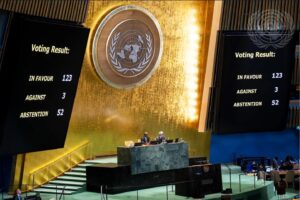
Copyright @nbcnews-The U.N. General Assembly Hall on Wednesday after the vote on a resolution declaring the trafficking of enslaved Africans “the gravest crime against humanity.”Manuel Elías / U.N. Photo
The vote, however, revealed divisions among member states. The United States, Argentina, and Israel voted against the resolution, which explicitly described slavery and the transatlantic slave trade as a “crime against humanity” and called for reparations. All 27 members of the European Union abstained, citing concerns over the language describing slavery as “the gravest crime against humanity.”
Gabriella Michaelidou, the Cypriot deputy UN ambassador whose government currently holds the EU’s six-month presidency, warned that such phrasing could imply “a hierarchy among atrocity crimes,” potentially creating diplomatic sensitivities regarding other human rights violations.
Ghanaian officials framed the adoption as a significant milestone in advancing justice, recognition, and healing for the millions affected by slavery. Discussions following the vote included John Dramani Mahama, emphasising the need for continued dialogue and public awareness around the transatlantic slave trade’s enduring legacy.
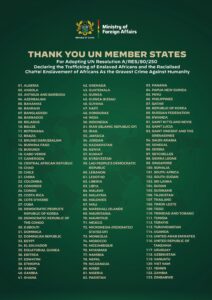
Countries-Adopted-the-Rseolution
The resolution further positions Ghana as a leading voice in global governance, highlighting its democratic credentials and influence in shaping international priorities such as sustainable development and global health.
While the resolution’s adoption is expected to strengthen international observance of the remembrance day and promote educational initiatives, the abstentions and opposing votes underscore ongoing debates over historical accountability, reparations, and the framing of atrocities within the UN system.
Africa
French-Congolese Music Star Gims Detained in Paris Over Alleged International Money Laundering


If Ebola Is Too Dangerous for America, It Is Too Dangerous for Kenya

AfCFTA Aims to Unite Africa’s Fragmented Markets Into a Single Trading Bloc
![President Denis Sassou Nguesso casts his vote at a polling station in Brazzaville during the Republic of Congo’s presidential election, 15 March 2026. [Congo Presidency/Handout via Reuters]](https://aukmedia.co.uk/wp-content/uploads/2026/04/DS-80x80.png)
Republic of Congo’s Denis Sassou Nguesso, 83, Secures Fifth Term in Power

Zia Yusuf from Reform UK Proposes Blocking Visas for Citizens of Countries Pursuing Slavery Reparations

ECOWAS at 50: President Obasanjo Warns of Declining Trust and Growing Divisions at Oxford Forum


