
Featured
Luton DART Celebrates 1 Million Passengers In Just 147 Days Since Launch!

Luton DART celebrates 1 million passengers in just 147 days since launch!
Luton (Direct-Air-Rail-Transit ) reached it 1 million passengers on Monday 21 August with Mr Wouter Ruffen, originally from the Netherlands, who has been backpacking around Europe, and was en route to a flight from London Luton to Amsterdam,
Wouter had bought a contactless ticket to the airport from London St Pancras International which included the Luton DART connection at Luton Airport Parkway station. He said it was straightforward navigating the trains and tapping at the gates and has now won free travel on the Luton DART for a year.
The DART system, which seamlessly whisks travellers between Luton Airport Parkway Station and the airport terminal in under four minutes, opened on 27 March.
The system enables a total journey time from the capital of just 32 minutes when passengers combine it with the Luton Airport Express fast train service out of London St Pancras. Councillor Javeria Hussain, Chair of Luton Rising, the Luton Council-owned company that owns the airport for community benefit, and built the Luton DART to improve the passenger experience significantly, said: “London Luton Airport is now operating at close to the passenger levels seen before the pandemic so it’s no surprise to see the Luton DART performing so well.”
Managing Director Nick Platts added: “We can see the benefits customers are receiving in terms of convenience, ease of travel and reduced journey times compared with the previous bus transfer service.”
“Already our passengers have saved themselves a total of around 20 years’ worth of travel time, and it is very pleasing that the service is running at 99.8 per cent reliability.
“More than that, every passenger using London Luton Airport and the Luton DART means more support for services in Luton and vulnerable people in particular who most need the help we fund through our unique £7.4m annual contribution to local voluntary, community and charitable organisations.”
Africa
Bola Tinubu at Windsor Castle: Nigeria Seeks Modern Economic Partnership Amid Global Tensions
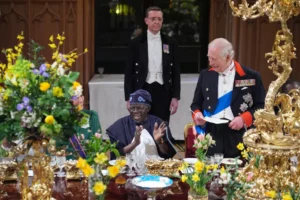
Bola Tinubu and King Charles III at Windsor Castle during the Nigerian president’s official visit to the UK.
© Royal Collection Enterprises Limited 2026 / Royal Collection Trust
Nigerian President’s first UK visit since 1989 highlights the country’s strategic role as Africa’s largest economy, a major oil producer, and a key partner for the UK, even as domestic insecurity and Middle East energy shocks complicate the path forward.
By Junior BADILA
In the carefully choreographed theatre of statecraft, few settings carry as much symbolic weight as Windsor Castle. When Bola Tinubu arrived at the royal residence this week, the meeting with King Charles III was about more than ceremony. It was a moment dense with historical echoes, economic ambition and geopolitical recalibration.
The visit has since moved from symbolism to substance. On Thursday morning, Tinubu was welcomed at 10 Downing Street by Keir Starmer, in talks expected to focus on trade, security cooperation and investment. The meeting reflects a mutual effort to deepen ties at a time when both governments are navigating domestic pressures and shifting global alliances.
Following the talks, the Nigerian delegation signalled a clear shift in tone. Officials described the visit as part of an effort to transform a long-standing historical relationship into what they called a “modern economic partnership”, reflecting a desire to move beyond legacy ties towards investment-driven cooperation in sectors such as energy, infrastructure, and finance. Notably, this is the first visit by a Nigerian head of state to the UK since 1979, underscoring both its rarity and significance.
Yet if the optics are reassuring, the realities underpinning the visit are far more complex. Nigeria remains one of the United Kingdom’s most important African partners and one of the strongest economies in sub-Saharan Africa. With a population approaching 250 million people, it is Africa’s most populous nation and one of the most strategically significant members of the Commonwealth of Nations.
Economically, Nigeria’s scale is undeniable. Its GDP—fluctuating between roughly $250bn and $360bn in recent years—places it among Africa’s largest economies, while its demographic weight gives it growing influence in global growth dynamics. Energy, however, remains the backbone of that influence. With around 37 billion barrels of proven oil reserves and production of roughly 1.5 million barrels per day, Nigeria ranks among the world’s leading oil producers and remains Africa’s top exporter.
This economic heft takes on amplified importance against the backdrop of escalating tensions in the Middle East involving Iran, the United States and Israel. Disruptions in the Strait of Hormuz, through which a significant portion of global oil supply passes, have sent energy prices soaring and heightened uncertainty for international markets. In this context, Nigeria’s oil output and stable production capacity make it an increasingly critical alternative supplier, linking the security of global energy to the stability of Africa’s largest economy. Its massive population also positions it as a key consumer market, further enhancing its geopolitical significance in the eyes of the UK and other global partners.
But the international relevance of Nigeria contrasts sharply with its domestic challenges. The country continues to face a resurgence of violence linked to Boko Haram. In cities such as Kano, Maiduguri and Gombe, insecurity remains pervasive, with civilians—often including Christian communities—frequently targeted.
Tinubu’s London visit therefore unfolds at a moment of acute internal strain. Economic reforms have triggered inflationary pressures, while insecurity continues to test the authority of the state. The situation has also drawn increasing international attention. Since US drone strikes targeting Islamist positions in northern Nigeria, Donald Trump has publicly questioned the strength of Nigeria’s leadership, adding to the scrutiny surrounding the administration.
At the same time, the domestic political landscape is shifting. With party primaries approaching, alliances are being reshaped. The People’s Democratic Party (PDP), long a central force in Nigerian politics, is positioning itself as a potential unifying platform amid fragmentation and public frustration.
For the UK, the stakes are clear. Nigeria is not simply another bilateral partner; it is a demographic giant, an energy supplier and a geopolitical actor whose stability matters far beyond its borders. For Nigeria, the relationship offers investment, diplomatic backing and access to global markets at a time when both are urgently needed.
Nigeria’s Global Economic Role Amid Middle East Tensions
Population: ~250 million – Africa’s largest, creating both a vast domestic market and strategic demographic weight within the Commonwealth.
GDP: $250–360 billion – among the top economies in sub-Saharan Africa, with growing influence in global growth projections.
Oil production: ~1.5 million barrels per day – 11th largest globally, nearly 1.7% of world output; Africa’s top exporter.
Reserves: ~37 billion barrels – providing a buffer against regional supply shocks.
Strategic significance:
- Global oil supply has been disrupted by tensions involving Iran, the US, and Israel, particularly through the Strait of Hormuz. Nigeria’s stable production offers an alternative for international markets.
- Its large population, combined with energy resources, positions Nigeria as both a critical supplier and an influential consumer in global markets.
- For the UK, Nigeria is a key African partner, not only in energy but also in trade, investment, and regional security.
Domestic pressures:
- Northern cities such as Kano, Maiduguri, and Gombe face attacks from Boko Haram, affecting both civilian safety and investor confidence.
- Economic reforms and inflationary pressures add to governance challenges, intensifying international scrutiny, including from figures such as former US President Donald Trump.
Political context:
- Party primaries are approaching, with the PDP seeking to emerge as a unifying political platform.
- Tinubu’s London visit aims to project stability, reinforce economic partnerships, and translate historical ties into modern investment-driven cooperation.
The images from Windsor and Downing Street tell a familiar story of diplomacy: handshakes, flags, and carefully worded communiqués. But beneath them lies a more consequential reality. In an era shaped by energy shocks, shifting alliances, and internal fragilities, Nigeria’s trajectory will not only define its own future—it will increasingly shape the balance of power between continents.
Whether Tinubu can translate presence into progress remains the central question.
Africa
Guinea-Bissau’s Political Storm: What the Military Interference Signals for ECOWAS and the Region
Africa
Generation Z vs. the Establishment: Madagascar’s Youth Rewrite the Rules


Bola Tinubu at Windsor Castle: Nigeria Seeks Modern Economic Partnership Amid Global Tensions

Guinea-Bissau’s Political Storm: What the Military Interference Signals for ECOWAS and the Region

Africa at COP30 in Belém, Brazil: Leading the Fight or Left Behind Again?

ECOWAS at 50: President Obasanjo Warns of Declining Trust and Growing Divisions at Oxford Forum

Why Are More Black Britons Applying to Oxford University?


