
Africa
South Africa: Julius Malema, Leader of EFF, Sentenced to Five Years in Prison Over Firearm Offence.
A South African court has handed a five-year prison sentence to Julius Malema, in a ruling that could ultimately disqualify one of the country’s most prominent political figures from serving in parliament.
Malema, leader of the Economic Freedom Fighters, remained in court in KuGompo City on Thursday as magistrates weighed whether to admit an appeal against the sentence. It was not immediately clear whether that process would delay any transfer to prison.
The 45-year-old was convicted last year on multiple charges stemming from a 2018 rally in the Eastern Cape, where he fired a rifle into the air inside a stadium. Delivering judgment, magistrate Twanet Olivier warned that impunity for such offences would pose “a serious threat to our democratic state”.
The court imposed five years for unlawful possession of a firearm and a further two years for unlawful possession of ammunition, alongside fines for additional offences, including discharging a firearm in a built-up area. The sentences are to run concurrently.
Under South Africa’s constitution, any prison term exceeding 12 months—once all appeals are exhausted—renders an individual ineligible to serve as a lawmaker. For Malema and his party, the implications are significant.
The EFF, parliament’s fourth-largest party, has built a strong following among younger South Africans disillusioned by the enduring inequalities that have persisted since the end of apartheid in 1994. Its platform—centred on the nationalisation of mines and land redistribution—has made Malema both a galvanising and polarising figure in the country’s political landscape.
Prosecutors argued that failing to impose a custodial sentence would set a dangerous precedent, urging the court to consider the maximum penalty of 15 years. Malema’s legal team, by contrast, maintained that the firearm was discharged as part of a celebratory gesture, with no intent to cause harm, and called for a more lenient sanction, such as a fine.
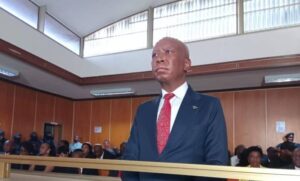
Julius Malema, leader of the Economic Freedom Fighters, during his appearance at the East London Magistrate’s Court on Wednesday. (Source: witness.co.za)
![President Denis Sassou Nguesso casts his vote at a polling station in Brazzaville during the Republic of Congo’s presidential election, 15 March 2026. [Congo Presidency/Handout via Reuters]](https://aukmedia.co.uk/wp-content/uploads/2026/04/DS-400x240.png)



Africa
If Ebola Is Too Dangerous for America, It Is Too Dangerous for Kenya
Africa
AfCFTA Aims to Unite Africa’s Fragmented Markets Into a Single Trading Bloc
Africa
Republic of Congo’s Denis Sassou Nguesso, 83, Secures Fifth Term in Power
The Republic of Congo’s president, Denis Sassou Nguesso, was sworn in this week after securing a fifth consecutive term, extending a rule that now spans nearly 42 years. Provisional results announced on Tuesday by the officials put his share of the vote at 94.82% on Sunday’s poll — a margin that, while striking, had been widely anticipated.
The official turnout figure, 84.65%, raised immediate questions. State television reported high participation, yet scenes from polling stations in the capital, Brazzaville, suggested a more subdued reality, with many centres registering thin crowds or none at all. The discrepancy has reinforced longstanding doubts about the transparency of the electoral process.
![President Denis Sassou Nguesso casts his vote at a polling station in Brazzaville during the Republic of Congo’s presidential election, 15 March 2026. [Congo Presidency/Handout via Reuters]](https://aukmedia.co.uk/wp-content/uploads/2026/04/DS-300x169.png)
President Denis Sassou Nguesso casts his vote at a polling station in Brazzaville during the Republic of Congo’s presidential election, 15 March 2026. [Congo Presidency/Handout via Reuters]
The election unfolded against the backdrop of an opposition boycott. Two key parties withdrew, alleging unfair conditions, while prominent figures such as General Jean-Marie Michel Mokoko and André Okombi Salissa — both imprisoned for nearly a decade — were absent from the contest. Their exclusion further narrowed an already limited field.
Restrictions in the run-up to the vote added to concerns. Internet access was cut, as has become routine during presidential elections, and movement across Brazzaville was constrained. Human rights groups reported arrests of activists, the suspension of opposition parties and tight monitoring of public gatherings, contributing to what critics describe as a climate of repression.
These dynamics reflect deeper structural patterns. Since returning to power after the 1997 civil war, Sassou Nguesso has consolidated control over state institutions. A 2015 constitutional referendum removed age and term limits, enabling him to extend his tenure and further entrench incumbency.
Yet the political continuity contrasts sharply with the country’s economic fragility. Despite significant oil and mineral wealth, the Republic of Congo remains heavily indebted. According to the World Bank, public debt stands at around 94.5% of gross domestic product, underscoring the persistent gap between resource revenues and broader development outcomes.
The scale of Sassou Nguesso’s victory, combined with the conditions under which it was secured, is likely to deepen scrutiny of both the electoral framework and the prospects for political pluralism. As the new term begins, questions around governance, economic management and eventual succession remain unresolved, even as the contours of power appear largely unchanged.


If Ebola Is Too Dangerous for America, It Is Too Dangerous for Kenya

AfCFTA Aims to Unite Africa’s Fragmented Markets Into a Single Trading Bloc
![President Denis Sassou Nguesso casts his vote at a polling station in Brazzaville during the Republic of Congo’s presidential election, 15 March 2026. [Congo Presidency/Handout via Reuters]](https://aukmedia.co.uk/wp-content/uploads/2026/04/DS-80x80.png)
Republic of Congo’s Denis Sassou Nguesso, 83, Secures Fifth Term in Power

Zia Yusuf from Reform UK Proposes Blocking Visas for Citizens of Countries Pursuing Slavery Reparations

ECOWAS at 50: President Obasanjo Warns of Declining Trust and Growing Divisions at Oxford Forum


