
Africa
Benin: Finance Minister Romuald Wadagni Wins Presidency with Landslide Victory
Benin’s finance minister, Romuald Wadagni, has won the country’s presidential election with a commanding 94% of the vote, according to provisional results released by the electoral commission (CENA), after more than 90% of ballots were counted.
The result confirms a widely anticipated victory for Wadagni, 49, who stood as the candidate of the ruling alliance between the Progressive Union Renewal (UPR) and the Republican Bloc (BR). His campaign was strongly backed by outgoing president Patrice Talon, who is constitutionally barred from seeking a third term after completing two five-year mandates.
Wadagni’s ascent caps a decade in which he served as finance minister, overseeing sustained economic growth averaging above 6% annually. He has pledged continuity of that trajectory in a country often cited as one of West Africa’s more stable democracies, despite a failed coup attempt in December 2025.
His only challenger, Paul Hounkpe of the FCBE party, conceded defeat while counting was still under way. In a statement, he extended “republican congratulations” and called for respect for democratic norms.
CENA chair Sacca Lafia said the vote had been conducted peacefully. Civil society observers reported around one hundred incident alerts, including early openings of polling stations and cases where ballot boxes appeared already full at opening time.
The Economic Community of West African States (ECOWAS) observer mission described a “peaceful atmosphere” and “smooth running” of the vote.
About 7.9 million citizens were registered to vote, with turnout recorded at 58.75% nationally. Participation was significantly lower in the capital, Porto-Novo, where it fell to between 20% and 40% in some polling stations.
However, the election took place under conditions criticised by analysts, who argue that political space has narrowed during Talon’s presidency. The main opposition party, Les Démocrates, was excluded from the ballot after failing to secure parliamentary endorsements required under constitutional changes introduced last year.
Those reforms, which tie presidential eligibility to legislative backing, effectively blocked opposition leader Renaud Agbodjo from qualifying for the race, as his party holds no seats in the National Assembly.
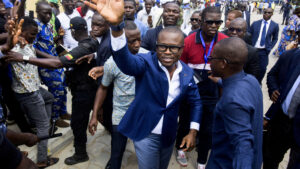
Romuald Wadagni campaigning in Cotonou, Benin, last month. He has been declared the country’s new president according to provisional results. Credit: Charles Placide Tossou/Reuters (via The New York Times)


![President Denis Sassou Nguesso casts his vote at a polling station in Brazzaville during the Republic of Congo’s presidential election, 15 March 2026. [Congo Presidency/Handout via Reuters]](https://aukmedia.co.uk/wp-content/uploads/2026/04/DS-400x240.png)




Africa
If Ebola Is Too Dangerous for America, It Is Too Dangerous for Kenya
Africa
AfCFTA Aims to Unite Africa’s Fragmented Markets Into a Single Trading Bloc
Africa
Republic of Congo’s Denis Sassou Nguesso, 83, Secures Fifth Term in Power
The Republic of Congo’s president, Denis Sassou Nguesso, was sworn in this week after securing a fifth consecutive term, extending a rule that now spans nearly 42 years. Provisional results announced on Tuesday by the officials put his share of the vote at 94.82% on Sunday’s poll — a margin that, while striking, had been widely anticipated.
The official turnout figure, 84.65%, raised immediate questions. State television reported high participation, yet scenes from polling stations in the capital, Brazzaville, suggested a more subdued reality, with many centres registering thin crowds or none at all. The discrepancy has reinforced longstanding doubts about the transparency of the electoral process.
![President Denis Sassou Nguesso casts his vote at a polling station in Brazzaville during the Republic of Congo’s presidential election, 15 March 2026. [Congo Presidency/Handout via Reuters]](https://aukmedia.co.uk/wp-content/uploads/2026/04/DS-300x169.png)
President Denis Sassou Nguesso casts his vote at a polling station in Brazzaville during the Republic of Congo’s presidential election, 15 March 2026. [Congo Presidency/Handout via Reuters]
The election unfolded against the backdrop of an opposition boycott. Two key parties withdrew, alleging unfair conditions, while prominent figures such as General Jean-Marie Michel Mokoko and André Okombi Salissa — both imprisoned for nearly a decade — were absent from the contest. Their exclusion further narrowed an already limited field.
Restrictions in the run-up to the vote added to concerns. Internet access was cut, as has become routine during presidential elections, and movement across Brazzaville was constrained. Human rights groups reported arrests of activists, the suspension of opposition parties and tight monitoring of public gatherings, contributing to what critics describe as a climate of repression.
These dynamics reflect deeper structural patterns. Since returning to power after the 1997 civil war, Sassou Nguesso has consolidated control over state institutions. A 2015 constitutional referendum removed age and term limits, enabling him to extend his tenure and further entrench incumbency.
Yet the political continuity contrasts sharply with the country’s economic fragility. Despite significant oil and mineral wealth, the Republic of Congo remains heavily indebted. According to the World Bank, public debt stands at around 94.5% of gross domestic product, underscoring the persistent gap between resource revenues and broader development outcomes.
The scale of Sassou Nguesso’s victory, combined with the conditions under which it was secured, is likely to deepen scrutiny of both the electoral framework and the prospects for political pluralism. As the new term begins, questions around governance, economic management and eventual succession remain unresolved, even as the contours of power appear largely unchanged.


If Ebola Is Too Dangerous for America, It Is Too Dangerous for Kenya

AfCFTA Aims to Unite Africa’s Fragmented Markets Into a Single Trading Bloc
![President Denis Sassou Nguesso casts his vote at a polling station in Brazzaville during the Republic of Congo’s presidential election, 15 March 2026. [Congo Presidency/Handout via Reuters]](https://aukmedia.co.uk/wp-content/uploads/2026/04/DS-80x80.png)
Republic of Congo’s Denis Sassou Nguesso, 83, Secures Fifth Term in Power

Zia Yusuf from Reform UK Proposes Blocking Visas for Citizens of Countries Pursuing Slavery Reparations

ECOWAS at 50: President Obasanjo Warns of Declining Trust and Growing Divisions at Oxford Forum


