Connect with us

Africa

Burkina Faso Dissolves NGOs in Push for State Sovereignty, Said Ibrahim Traore Amid Rising tensions with civil society

Burkina Faso’s military authorities have ordered the dissolution of more than 100 civil society organisations, in a sweeping move that rights groups say marks a deepening assault on fundamental freedoms.

The decree, announced on Wednesday by the Ministry of Territorial Administration, mandates the closure of 118 associations and non-governmental organisations and prohibits their activities, citing compliance with existing legal provisions. Many of the affected groups are engaged in human rights advocacy.

The decision represents the latest step in a broader tightening of political space under the junta led by Ibrahim Traoré, which seized power in a 2022 coup and has since moved to curb opposition, trade unions and public assembly.

In recent months, the government has escalated its campaign against organised civil society. A law introduced last year imposed new restrictions on the operations of rights groups, followed by suspensions and revocations of permits for dozens of organisations on administrative grounds. Earlier this year, political parties were formally dissolved after a prolonged suspension.

Officials have framed the measures as necessary to enforce regulatory compliance, with territorial administration minister Emile Zerbo warning that any breach of the new rules would be met with legal sanctions.

Human rights organisations have sharply criticised the move. Amnesty International described the dissolutions as a “flagrant attack” on freedom of association and warned of an intensifying crackdown on civic space in the Sahel state.

Analysts see the latest decree as part of a broader strategy to consolidate authority and limit dissent, as the government continues to confront a protracted insurgency linked to groups affiliated with al-Qaeda and Islamic State. Authorities have repeatedly accused some internationally funded organisations of acting as conduits for foreign interference, a claim civil society actors strongly deny.

The dissolutions underscore the increasingly fraught relationship between the state and civil society in Burkina Faso, where the boundaries of political participation continue to narrow under military rule.

Africa

DR Congo Faces Political Backlash Over US Deportees Agreement Amid Security and Governance Concerns

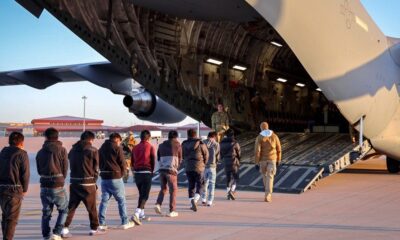
An opposition MP in the Democratic Republic of the Congo has requested a parliamentary debate over a reported agreement to receive deportees from the United States, triggering political backlash and civil society opposition amid heightened insecurity and institutional strain.

Christian Mwando Simba, a member of parliament and opposition figure, submitted an oral question to the National Assembly calling on the Minister of Foreign Affairs to appear before lawmakers and publicly explain the rationale and legal basis for accepting deportees from the US.

He questioned the relevance of the arrangement at a time when parts of the country remain affected by armed conflict, widespread insecurity, and what he described as weakening state capacity.

The intervention follows reporting that Congo is preparing to receive a group of deportees from the United States, all of whom are said to be nationals of third countries, not Congolese citizens. The move has been framed by officials as part of broader migration cooperation with Washington, which has increasingly sought agreements with African states to facilitate removals of individuals whose countries of origin are difficult to access directly.

However, the proposal has drawn criticism domestically. The civil society platform “Forces vives” has firmly rejected the idea of hosting migrants expelled from the United States, warning of social and political risks linked to the arrangement.

Jean-Bosco Lalo, speaking for the group, called on Congolese citizens to “stand united” against what he described as a measure that could prove “harmful” to the country’s long-term future.

The controversy underscores growing sensitivity in Kinshasa around migration policy being shaped through external agreements, particularly in a context where the state is already managing security pressures in eastern provinces and broader governance challenges.

Authorities have maintained that any arrangement falls within international cooperation frameworks and is limited in scope, but pressure is mounting for formal parliamentary scrutiny and public clarification.

Continue Reading

Africa

Why was Pan-African Activist Kemi Seba Arrested in South Africa?

South African authorities have arrested the pan-African activist Kemi Seba, and initiated extradition proceedings linked to a Benin-issued warrant over allegations of “inciting rebellion”.

Benin issued the warrant in December 2025 following Seba’s public support for an attempted coup that was later suppressed. He is accused of undermining state authority, allegations his supporters frame as part of a wider pattern of political criminalisation of dissenting pan-African currents.

South African police said Seba was detained at a shopping centre in Pretoria alongside his 18-year-old son and a South African national. He remains in custody as investigations continue.

Born Stellio Gilles Robert Capo Chichi in France to Beninese parents, Seba has long positioned himself as a critic of French influence in Africa, advocating for political and economic sovereignty across the continent and aligning himself with emerging anti-Western alliances in the Sahel, including governments that have deepened ties with Russia.

South African Police allege the group was preparing to move across borders through irregular channels, with assistance from a South African intermediary. Cash and electronic devices were reportedly seized during the arrest.

The case places Seba once again at the centre of a widening geopolitical fault line in West Africa and beyond, where competing visions of sovereignty, security, and external influence are increasingly contested between traditional Western partners and rising pan-African and multipolar blocs.

Seba, his son, and the South African national are due to remain in custody pending further proceedings.

Continue Reading

Africa

South Africa: Julius Malema, Leader of EFF, Sentenced to Five Years in Prison Over Firearm Offence.

A South African court has handed a five-year prison sentence to Julius Malema, in a ruling that could ultimately disqualify one of the country’s most prominent political figures from serving in parliament.

Malema, leader of the Economic Freedom Fighters, remained in court in KuGompo City on Thursday as magistrates weighed whether to admit an appeal against the sentence. It was not immediately clear whether that process would delay any transfer to prison.

The 45-year-old was convicted last year on multiple charges stemming from a 2018 rally in the Eastern Cape, where he fired a rifle into the air inside a stadium. Delivering judgment, magistrate Twanet Olivier warned that impunity for such offences would pose “a serious threat to our democratic state”.

The court imposed five years for unlawful possession of a firearm and a further two years for unlawful possession of ammunition, alongside fines for additional offences, including discharging a firearm in a built-up area. The sentences are to run concurrently.

Under South Africa’s constitution, any prison term exceeding 12 months—once all appeals are exhausted—renders an individual ineligible to serve as a lawmaker. For Malema and his party, the implications are significant.

The EFF, parliament’s fourth-largest party, has built a strong following among younger South Africans disillusioned by the enduring inequalities that have persisted since the end of apartheid in 1994. Its platform—centred on the nationalisation of mines and land redistribution—has made Malema both a galvanising and polarising figure in the country’s political landscape.

Prosecutors argued that failing to impose a custodial sentence would set a dangerous precedent, urging the court to consider the maximum penalty of 15 years. Malema’s legal team, by contrast, maintained that the firearm was discharged as part of a celebratory gesture, with no intent to cause harm, and called for a more lenient sanction, such as a fine.

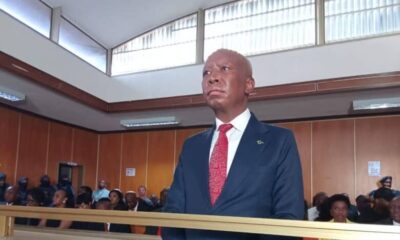
Julius Malema, leader of the Economic Freedom Fighters, during his appearance at the East London Magistrate’s Court on Wednesday. (Source: witness.co.za)

Julius Malema, leader of the Economic Freedom Fighters, during his appearance at the East London Magistrate’s Court on Wednesday. (Source: witness.co.za)

Continue Reading