Highlights
Luton DART to be opened in 2023
The announcement of an official opening date for the pioneering Luton Direct Air-Rail Transit (DART) infrastructure project will be made in early 2023, Luton Rising has confirmed.
The Luton DART is a new cable-hauled fast passenger transit that will connect Luton Airport Parkway station to London Luton Airport, the UK’s fifth largest, in just over three minutes.
It will offer direct, seamless, sustainable travel to London Luton Airport from more than 60 stations across the Thameslink & East Midlands Railway network, replacing the existing bus transfer service. The journey from London St Pancras International to London Luton Airport terminal will take just over 30 minutes on the fastest trains.
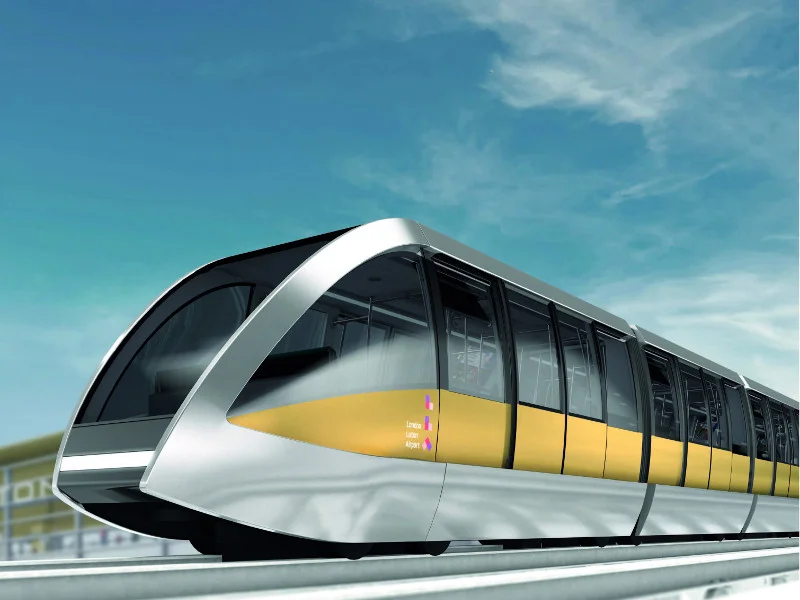 (Luton DART, picture from Railway Technology, February 2020)
The Luton DART is a major local investment by airport owner Luton Rising and Luton Council aimed at increasing the rail modal share for passengers accessing the airport and supporting the delivery of the Luton 2040 vision of a carbon-neutral town by reducing the environmental impact of journeys to and from the airport and congestion on surrounding roads.
Luton DART will also Improve London Luton Airport’s competitive position within the London aviation system, deliver a game-changing passenger experience at London Luton Airport and support the future sustainable growth of London Luton Airport.
London Luton Airport already sustains 10,000 direct jobs and another 17,000 in the local and regional supply chains. Construction of the Luton DART has supported around 500 additional jobs across a range of disciplines, creating 80 full-time posts for local apprentices, graduates, and other new entrants, and providing construction skills training hub for 720 people, of whom over 40{a27b5a5db6b93980f23a4ed319468d0ba38eeb13d044ef3318f2b2f37da02f4f} were drawn from traditionally under-represented groups.
According to Graham Oliver, Chief Executive Officer of Luton Rising, “The Luton DART is one of the biggest infrastructure projects ever undertaken in Luton and will put our town and our airport firmly on the map for all the right reasons.
“Testing of the system is significantly advanced, but there remain several important tasks that we are working to complete with our partners, which relate mostly to complexities of the communications infrastructure and enabling works. This will also allow us more time to complete all the regulatory, operational, and health and safety testing.”
In addition to providing more than £257m for frontline services in Luton since 1998, Luton Rising has provided more than £155m to local community projects that support and improve people’s lives.
Mr. Oliver added: “The Luton DART is a vital investment that signals our commitment to the ongoing success of the airport for the benefit of our passengers, airlines, and the people of Luton. Everything that we do is aimed not only at supporting economic and employment growth but generating positive outcomes for the community and acting in an environmentally responsible way.
“Electrically powered, energy-efficient, and future-proofed to support the sustainable growth of the airport, the Luton DART helps us continue to deliver social impact on a scale well beyond any other UK airport.
“We had hoped for an announcement of opening in 2022. We are eager to open the Luton DART and will do so as soon as we are assured that passengers will get the world-class service they deserve.”

Africa
Benin: Finance Minister Romuald Wadagni Wins Presidency with Landslide Victory
Benin’s finance minister, Romuald Wadagni, has won the country’s presidential election with a commanding 94% of the vote, according to provisional results released by the electoral commission (CENA), after more than 90% of ballots were counted.
The result confirms a widely anticipated victory for Wadagni, 49, who stood as the candidate of the ruling alliance between the Progressive Union Renewal (UPR) and the Republican Bloc (BR). His campaign was strongly backed by outgoing president Patrice Talon, who is constitutionally barred from seeking a third term after completing two five-year mandates.
Wadagni’s ascent caps a decade in which he served as finance minister, overseeing sustained economic growth averaging above 6% annually. He has pledged continuity of that trajectory in a country often cited as one of West Africa’s more stable democracies, despite a failed coup attempt in December 2025.
His only challenger, Paul Hounkpe of the FCBE party, conceded defeat while counting was still under way. In a statement, he extended “republican congratulations” and called for respect for democratic norms.
CENA chair Sacca Lafia said the vote had been conducted peacefully. Civil society observers reported around one hundred incident alerts, including early openings of polling stations and cases where ballot boxes appeared already full at opening time.
The Economic Community of West African States (ECOWAS) observer mission described a “peaceful atmosphere” and “smooth running” of the vote.
About 7.9 million citizens were registered to vote, with turnout recorded at 58.75% nationally. Participation was significantly lower in the capital, Porto-Novo, where it fell to between 20% and 40% in some polling stations.
However, the election took place under conditions criticised by analysts, who argue that political space has narrowed during Talon’s presidency. The main opposition party, Les Démocrates, was excluded from the ballot after failing to secure parliamentary endorsements required under constitutional changes introduced last year.
Those reforms, which tie presidential eligibility to legislative backing, effectively blocked opposition leader Renaud Agbodjo from qualifying for the race, as his party holds no seats in the National Assembly.
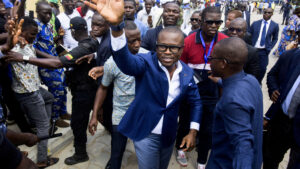
Romuald Wadagni campaigning in Cotonou, Benin, last month. He has been declared the country’s new president according to provisional results. Credit: Charles Placide Tossou/Reuters (via The New York Times)
Africa
Cameroon’s Paul Biya Appoints Son as Vice-President in Move that Revives Abolished Post
In a decision likely to intensify debate over succession and democratic governance, Paul Biya has appointed his son, Franck Emmanuel Biya, as vice-president of Cameroon, according to a presidential decree issued on 4 April.
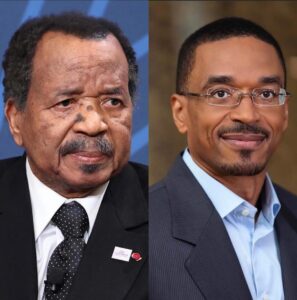
Paul Biya Appoints Son Franck Emmanuel Biya as Vice President Picture- Source @diasporamessenger
The move marks a significant departure from the country’s long-standing constitutional framework, reintroducing a post that had been scrapped more than five decades ago. The office of vice-president was abolished in 1972, when sweeping constitutional reforms concentrated executive authority in the presidency.
Analysts say the decision represents more than an administrative reshuffle. It signals a potential recalibration of the political order in Yaoundé, where questions of leadership transition have lingered for years. By elevating a close family member to the second-highest office in the state, the decree is expected to fuel scrutiny over the prospects of dynastic succession in one of Africa’s longest-standing presidencies.
While the government has yet to provide detailed justification for the institutional change, the reinstatement of the vice-presidency introduces a new layer to Cameroon’s executive structure—one that may prove decisive in shaping the country’s political trajectory in the years ahead.
Africa
Can Winnie Odinga Win ODM’s Hearts?
Winnie Odinga’s political positioning reflects a deliberate attempt to reconcile two competing forces within the Orange Democratic Movement (ODM): the entrenched authority of legacy leadership embodied by Raila Odinga, and mounting pressure from a politically assertive, increasingly disillusioned youth constituency.
Her role in the East African Legislative Assembly provides regional stature, but her domestic challenge is institutional. She is not merely amplifying youth rhetoric; she is attempting to re-engineer ODM’s functional identity—from a historically anchored opposition vehicle into a platform capable of absorbing generational demands, particularly those of Gen Z voters focused on unemployment, governance deficits, and political inclusion.
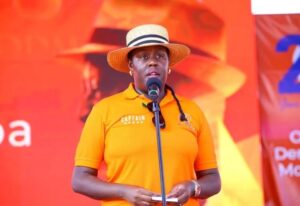
Winnie Odinga- Picture @ODM’s rally.
This intervention comes at a structurally sensitive moment. The Odinga family’s consolidation of control at the March 26 Special Delegates Convention signals organisational continuity, yet also reveals internal fragilities. ODM’s cohesion is increasingly contingent, with latent factionalism posing a credible threat to its electoral durability. Within this framework, Winnie Odinga’s outreach operates as both renewal strategy and pre-emptive stabilisation.
The ambiguity of ODM’s relationship with President William Ruto further complicates this recalibration. For younger constituencies, perceived proximity to executive power dilutes ODM’s oppositional credibility and creates ideological inconsistency. A party positioning itself as a counterweight to government while engaging in tacit alignment risks strategic incoherence. Winnie Odinga’s framing implicitly recognises this contradiction, though it remains politically sensitive to address directly.
Her intervention at the Linda Ground Special Delegates Convention sharpened this positioning. By elevating grassroots grievances—particularly from unemployed graduates—she reframed youth disengagement as a systemic failure of party architecture rather than generational apathy. Her critique of performative participation—limited to rallies and mobilisation—targets a structural feature of Kenyan party politics: the extraction of youth energy without corresponding inclusion in decision-making.
Her call for a “new ODM” was explicit in its direction. She urged the party to revert to its foundational ethos as a platform for the marginalised, while embedding youth participation within policy formulation and internal negotiations. This framing moves beyond symbolic inclusion toward institutional redesign—an agenda that, if implemented, would materially alter intra-party power distribution.
However, alignment with youth sentiment does not automatically convert into durable political capital. Three structural constraints remain.
First, dynastic optics. Operating within the Odinga political lineage confers visibility but also reinforces perceptions of elite continuity. Among Gen Z voters sceptical of inherited power, this creates a credibility threshold that reformist messaging alone may not overcome.
Second, institutional inertia within ODM. Senior figures, including Oburu Oginga, have signalled openness, particularly following his elevation within party leadership. Yet absent formal mechanisms—such as youth representation quotas or participatory policy frameworks—these assurances risk remaining declarative rather than operational.
Third, unresolved strategic positioning vis-à-vis the Ruto administration. Without a clearly defined stance, ODM’s internal messaging—especially to politically conscious youth—remains fragmented. A constituency oriented toward accountability is unlikely to respond to ambiguity on whether the party is oppositional or accommodative.
Analytically, Winnie Odinga’s political project is viable but conditional. Its success hinges on her capacity to translate discursive advocacy into institutional reform, while constructing a leadership identity that is distinct from, rather than derivative of, the broader Odinga legacy.
Her intervention has nonetheless catalysed a substantive debate about ODM’s future trajectory and the role of youth within Kenya’s political system. The outcome of this internal contest—between continuity and adaptation—will determine whether ODM can remain electorally relevant in an environment increasingly shaped by generational politics.


If Ebola Is Too Dangerous for America, It Is Too Dangerous for Kenya

AfCFTA Aims to Unite Africa’s Fragmented Markets Into a Single Trading Bloc
![President Denis Sassou Nguesso casts his vote at a polling station in Brazzaville during the Republic of Congo’s presidential election, 15 March 2026. [Congo Presidency/Handout via Reuters]](https://aukmedia.co.uk/wp-content/uploads/2026/04/DS-80x80.png)
Republic of Congo’s Denis Sassou Nguesso, 83, Secures Fifth Term in Power

Zia Yusuf from Reform UK Proposes Blocking Visas for Citizens of Countries Pursuing Slavery Reparations

ECOWAS at 50: President Obasanjo Warns of Declining Trust and Growing Divisions at Oxford Forum


