
AUK Radio
Cultur’us With Valma James
Africa
Ghana to Introduce Visa-Free Entry for All Africans in Pan-African Push
Ghana is to grant visa-free access to all African nationals, in a move the government says will deepen regional integration and reaffirm the country’s historic role at the centre of Pan-Africanism.
President John Mahama announced the policy during a state visit by Emmerson Mnangagwa, declaring that the measure will take effect on 25 May, the annual commemoration of Africa Day.
The decision positions Ghana among a small but growing group of African states seeking to dismantle long-standing barriers to movement across the continent. Officials in Accra argue that restrictive visa regimes have historically constrained trade, tourism and labour mobility within Africa, despite decades of political commitments to integration.
Under the new framework, travellers will be able to enter Ghana without prior visa approval, with the scheme forming part of a broader digital migration system centred on a forthcoming e-visa platform. Authorities say the reform is intended to streamline border processes while maintaining security oversight.

Visa Free To All Africans
The policy also carries economic intent. Ghanaian officials expect the move to stimulate intra-African commerce and increase visitor flows at a time when many African economies are seeking to diversify growth beyond commodity exports. Tourism, in particular, is likely to be an early beneficiary, as airlines and hospitality operators respond to reduced administrative friction for travellers.
Mahama used the announcement to signal a wider diplomatic effort. He said the government would intensify negotiations on reciprocal visa waiver agreements for Ghanaian citizens, noting that more than 20 such arrangements have been secured over the past year. The objective, he indicated, is to ensure that mobility gains are not one-sided but embedded within a broader framework of continental reciprocity.
The initiative aligns with ambitions underpinning the African Continental Free Trade Area (AfCFTA), which seeks not only to liberalise trade but also to ease the movement of people and services. Analysts caution, however, that implementation will be decisive. Past attempts across the continent have often faltered at the level of border enforcement, infrastructure capacity and inter-agency coordination.
Even so, the symbolism is difficult to ignore. By tying the policy’s launch to Africa Day, Ghana is drawing a direct line between contemporary economic strategy and the ideological legacy of Pan-African unity — a legacy the country has long claimed as part of its political identity.
If effectively executed, the visa-free regime could mark a substantive shift in how African states approach mobility: not as a security risk to be contained, but as an economic asset to be unlocked.
Africa
Ghana Welcomes UN Backing for Slavery Remembrance Day As a Call for Justice and Healing Renewed
Ghana has expressed its “sincere appreciation” to UN member states following the adoption of Resolution A/RES/80/250 on 25 March 2026, which formally recognises the International Day for the Remembrance of the Victims of Slavery and the Transatlantic Slave Trade.
The resolution was approved by 123 countries in the UN General Assembly, with all 15 members of the United Nations Security Council reportedly voting in favour.
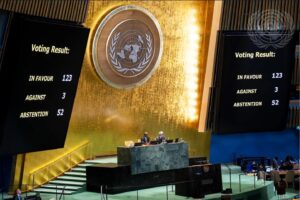
Copyright @nbcnews-The U.N. General Assembly Hall on Wednesday after the vote on a resolution declaring the trafficking of enslaved Africans “the gravest crime against humanity.”Manuel Elías / U.N. Photo
The vote, however, revealed divisions among member states. The United States, Argentina, and Israel voted against the resolution, which explicitly described slavery and the transatlantic slave trade as a “crime against humanity” and called for reparations. All 27 members of the European Union abstained, citing concerns over the language describing slavery as “the gravest crime against humanity.”
Gabriella Michaelidou, the Cypriot deputy UN ambassador whose government currently holds the EU’s six-month presidency, warned that such phrasing could imply “a hierarchy among atrocity crimes,” potentially creating diplomatic sensitivities regarding other human rights violations.
Ghanaian officials framed the adoption as a significant milestone in advancing justice, recognition, and healing for the millions affected by slavery. Discussions following the vote included John Dramani Mahama, emphasising the need for continued dialogue and public awareness around the transatlantic slave trade’s enduring legacy.
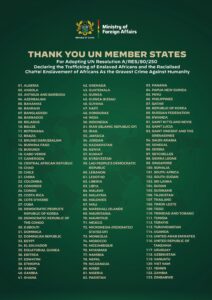
Countries-Adopted-the-Rseolution
The resolution further positions Ghana as a leading voice in global governance, highlighting its democratic credentials and influence in shaping international priorities such as sustainable development and global health.
While the resolution’s adoption is expected to strengthen international observance of the remembrance day and promote educational initiatives, the abstentions and opposing votes underscore ongoing debates over historical accountability, reparations, and the framing of atrocities within the UN system.
Africa
Barbadians launch initiative to support Cubans amid ongoing US blockade.


If Ebola Is Too Dangerous for America, It Is Too Dangerous for Kenya

AfCFTA Aims to Unite Africa’s Fragmented Markets Into a Single Trading Bloc
![President Denis Sassou Nguesso casts his vote at a polling station in Brazzaville during the Republic of Congo’s presidential election, 15 March 2026. [Congo Presidency/Handout via Reuters]](https://aukmedia.co.uk/wp-content/uploads/2026/04/DS-80x80.png)
Republic of Congo’s Denis Sassou Nguesso, 83, Secures Fifth Term in Power

Zia Yusuf from Reform UK Proposes Blocking Visas for Citizens of Countries Pursuing Slavery Reparations

ECOWAS at 50: President Obasanjo Warns of Declining Trust and Growing Divisions at Oxford Forum


