
Africa
DR Congo Set to Receive US-Deported Third-Country Nationals
The government of Democratic Republic of the Congo has confirmed it will begin receiving third-country nationals deported from the United States under a newly announced agreement with the administration of Donald Trump, in a move that is already raising legal and ethical questions.
In a statement issued in Kinshasa on Sunday, authorities said the transfers would commence in April, though officials declined to specify how many individuals would be accepted under the arrangement. The policy places Congo among a growing number of African states enlisted by Washington to host deportees who are not nationals of the receiving country.
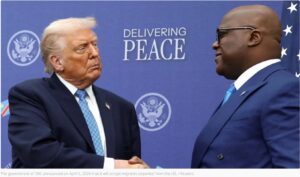
Dec. 20025- D.Trump and F. Tshisekedi Signing a Treaty of Peace @Reuters
According to the Congolese government, the programme will be fully financed by the United States, with no direct cost to the national budget. Infrastructure has reportedly been prepared on the outskirts of Kinshasa to accommodate arrivals, suggesting a degree of logistical planning already underway.
The deal mirrors similar arrangements previously concluded with countries including Ghana, Cameroon, Equatorial Guinea and Eswatini. These agreements have drawn sustained criticism from legal scholars and human rights organisations, who argue that transferring deportees to third countries raises serious concerns over due process, accountability and the protection of fundamental rights.
The timing of the agreement is notable. It coincides with renewed diplomatic efforts by Washington to stabilise relations between Democratic Republic of the Congo and Rwanda, amid persistent tensions in the eastern regions. At the same time, negotiations have intensified over access to Congo’s vast reserves of critical minerals—resources that are central to global supply chains in energy transition technologies.
Taken together, the arrangement underscores a broader recalibration of US policy in central Africa, where migration control, regional security and strategic resource interests are increasingly intertwined. Critics, however, warn that such deals risk externalising immigration enforcement while placing additional strain on countries already grappling with complex domestic challenges.


Africa
Zia Yusuf from Reform UK Proposes Blocking Visas for Citizens of Countries Pursuing Slavery Reparations
Zia Yusuf, Reform UK’s home affairs spokesperson, has announced plans to deny visas to citizens of any country pursuing compensation for Britain’s historical role in the transatlantic slave trade, a move that has drawn international attention.
He described reparations claims as “insulting,” noting that 3.8 million visas have been issued over the past 20 years to nationals from countries making such demands.
The transatlantic slave trade, conducted over four centuries by seven European powers including the UK, forcibly transported more than 15 million Africans. Scholars link the wealth generated from slavery to the industrial rise of the West, a legacy that continues to shape global economic and social disparities.
Last month, the UN recognised the transatlantic slave trade as the “gravest crime against humanity” and called for reparations as a step toward remedying historical injustices. The resolution, proposed by Ghana’s President John Dramani Mahama and endorsed by the African Union and Caricom (Caribbean Community), was abstained by the UK and EU members, while the US, Israel and Argentina voted against it.
Yusuf argued that Britain had made “huge sacrifices” by being the first major power to abolish slavery and enforce its prohibition, insisting that the UK would no longer tolerate being “ridiculed on the world stage.” He added that countries pressing for reparations were attempting to “use history as a weapon to drain our treasury” and stressed that Reform UK would also cut international aid to nations making such claims.
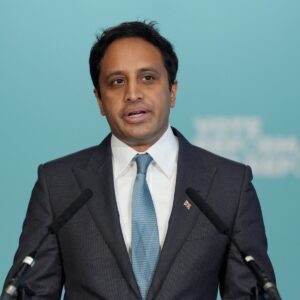
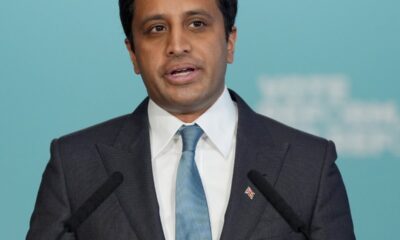
Yusuf Zia, UK Reform Home Affairs Spokesman, appears in Picture @Ghana Chronicles X’s account.
Africa
DR Congo Secures Duty-Free Access to China, Strengthening Mining Competitiveness
The Democratic Republic of Congo has moved to deepen its economic engagement with China, formalising a new phase of cooperation centred on geology and mineral resources, as Kinshasa seeks to extract greater value from its vast natural wealth.
During a visit to Beijing on March 26, 2026, Congolese officials signed a memorandum of understanding with China’s Ministry of Natural Resources, led by Minister Guan Zhi’ou. The agreement sets out a structured framework for collaboration, underpinned by regular institutional dialogue, guarantees on investment protection and a commitment to operate within Congo’s legal and regulatory regime.
Crucially, the deal places renewed emphasis on local value creation, with both sides endorsing the development of domestic processing capacity rather than the continued export of raw materials. This reflects a broader shift in Congolese policy aimed at capturing a larger share of the mining value chain.
The agreement comes with immediate commercial incentives. From May 1, 2026, Congolese exports to China will benefit from duty-free access, a move expected to improve the competitiveness of the country’s mining sector and support near-term growth. Officials on both sides have also committed to establishing a joint monitoring mechanism designed to oversee implementation, ensure regulatory compliance and provide a stable environment for investors.
Particular attention is being directed towards large-scale industrial projects, notably the Grande Orientale Iron Mines (MIFOR). The project, which has drawn significant interest from Chinese partners, is expected to begin with an annual output of 50m tonnes of iron, with ambitions to scale up to 300m tonnes over time. Initial investment is estimated at $28.9bn, positioning it among the most capital-intensive mining developments on the continent.
The strengthening of ties with Beijing comes at a moment of intensifying geopolitical competition over critical minerals, with Kinshasa increasingly leveraging its resource base to negotiate partnerships on more favourable terms. Congolese officials maintain that diversified engagement — including with China and Western partners — remains central to their strategy.
Looking ahead, the Congolese minister has been invited to participate in the International Forum of Ministers of Mines in September, where a joint intervention with his Chinese counterpart is under consideration, signalling continued high-level coordination between the two countries.
The Democratic Republic of Congo has moved to deepen its economic engagement with China, formalising a new phase of cooperation centred on geology and mineral resources, as Kinshasa seeks to extract greater value from its vast natural wealth.
During a visit to Beijing on March 26, 2026, Congolese officials signed a memorandum of understanding with China’s Ministry of Natural Resources, led by Minister Guan Zhi’ou. The agreement sets out a structured framework for collaboration, underpinned by regular institutional dialogue, guarantees on investment protection and a commitment to operate within Congo’s legal and regulatory regime.
Crucially, the deal places renewed emphasis on local value creation, with both sides endorsing the development of domestic processing capacity rather than the continued export of raw materials. This reflects a broader shift in Congolese policy aimed at capturing a larger share of the mining value chain.
The agreement comes with immediate commercial incentives. From May 1, 2026, Congolese exports to China will benefit from duty-free access, a move expected to improve the competitiveness of the country’s mining sector and support near-term growth. Officials on both sides have also committed to establishing a joint monitoring mechanism designed to oversee implementation, ensure regulatory compliance and provide a stable environment for investors.
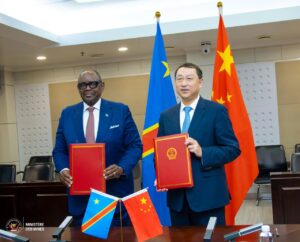
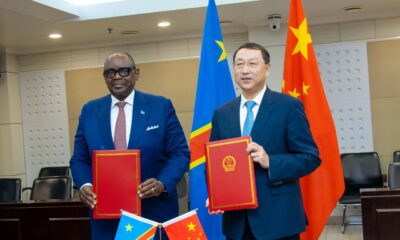
March 26th in Beijing-DR Congo’s Minister Louis Watum and China’s Minister of Natural Resources, Guan Zhi’ou, signing MoU.
Particular attention is being directed towards large-scale industrial projects, notably the Grande Orientale Iron Mines (MIFOR). The project, which has drawn significant interest from Chinese partners, is expected to begin with an annual output of 50m tonnes of iron, with ambitions to scale up to 300m tonnes over time. Initial investment is estimated at $28.9bn, positioning it among the most capital-intensive mining developments on the continent.
The strengthening of ties with Beijing comes at a moment of intensifying geopolitical competition over critical minerals, with Kinshasa increasingly leveraging its resource base to negotiate partnerships on more favourable terms. Congolese officials maintain that diversified engagement — including with China and Western partners — remains central to their strategy.
Looking ahead, the Congolese minister has been invited to participate in the International Forum of Ministers of Mines in September, where a joint intervention with his Chinese counterpart is under consideration, signalling continued high-level coordination between the two countries.
Africa
Is the DRC Emerging as the U.S.’s Strongest Ally in the Great Lakes? New Pact Links Deportees Transfers to Security and Mineral Access


Zia Yusuf from Reform UK Proposes Blocking Visas for Citizens of Countries Pursuing Slavery Reparations

DR Congo Secures Duty-Free Access to China, Strengthening Mining Competitiveness

Is the DRC Emerging as the U.S.’s Strongest Ally in the Great Lakes? New Pact Links Deportees Transfers to Security and Mineral Access

ECOWAS at 50: President Obasanjo Warns of Declining Trust and Growing Divisions at Oxford Forum

Why Are More Black Britons Applying to Oxford University?


