
United Kingdom
UK Summit on Strait of Hormuz: Nigeria Sole African Invitee
Britain has accused Iran of endangering the global economy, as more than 40 countries convene urgent talks aimed at reopening the Strait of Hormuz — a vital artery for the world’s energy supply.
The narrow waterway, linking the Persian Gulf to international shipping lanes, has been largely closed for over a month amid escalating conflict involving the United States, Israel, and Iran. Under normal conditions, roughly a fifth of global oil and gas flows through the strait, making the disruption one of the most consequential supply shocks in recent years.
Opening the virtual summit, Britain’s foreign secretary, Yvette Cooper, delivered a stark assessment of the crisis, accusing Tehran of weaponising maritime access. She warned that the closure had already triggered rising fuel and food prices, with cascading effects on households and industries worldwide.
“We have seen Iran hijack an international shipping route to hold the global economy hostage,” she said, framing the crisis as both a geopolitical and economic emergency.
The meeting brings together a broad coalition spanning Europe, Asia, the Middle East, Africa, and the Americas. Invited countries include: United Kingdom, France, Germany, Italy, the Netherlands, Japan, Canada, Republic of Korea, New Zealand, Denmark, Latvia, Slovenia, Estonia, Norway, Sweden, Finland, Czechia, Romania, Bahrain, Lithuania, Australia, United Arab Emirates, Portugal, Trinidad & Tobago, Croatia, Bulgaria, Kosovo, Panama, North Macedonia, Nigeria, Montenegro, Albania, Marshall Islands, Chile, Moldova, Greece, and Somalia. The UK is convening 35 nations to explore diplomatic and political solutions for reopening the strait.
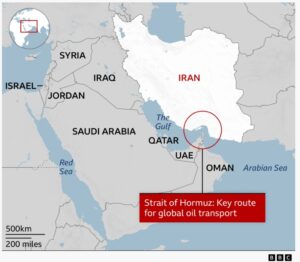
Strait of Hormuz @BBC
British prime minister Keir Starmer said the talks would focus on identifying “all viable diplomatic and political measures” to restore freedom of navigation, ensure the safety of stranded vessels and crews, and resume the flow of critical commodities. A follow-up round of discussions, led jointly with France, is expected within days.
Downing Street described the gathering as the first coordinated attempt to develop a practical roadmap for reopening the strait. Military planners are expected to assess operational scenarios once hostilities subside, though officials emphasised that the immediate priority remains diplomatic de-escalation rather than direct intervention.
The scale of disruption is already severe. Around 1,000 ships are estimated to be stranded, as Iran’s partial blockade — imposed in response to US and Israeli strikes — continues to choke one of the world’s busiest maritime corridors. Before the crisis, tanker traffic through the strait averaged hundreds of vessels per week, transporting not only hydrocarbons but also a significant share of global fertiliser supplies critical to food production systems.
Industry leaders, consulted earlier this week in London, have cautioned that restoring normal operations will be neither quick nor straightforward. Security concerns, rather than insurance constraints, remain the primary obstacle to resuming transit, with shipping companies unwilling to risk vessels and crews in an active conflict zone.
Starmer acknowledged the complexity of the challenge, warning that even after fighting ceases, clearing the route and rebuilding confidence in its safety could take considerable time. “This will not be easy,” he said, underscoring the need for a coordinated approach combining diplomatic pressure, military readiness, and close cooperation with the private sector.
Meanwhile, rhetoric from Washington has further complicated the diplomatic landscape. Former US president Donald Trump stated that countries dependent on the strait should take greater responsibility for securing it, criticising European allies for what he described as insufficient support. He also indicated that any cessation of US military action would depend on Iran relinquishing control over the waterway.
For its part, Iran’s Revolutionary Guards have signalled no immediate intention to reopen the route, declaring the strait closed to what they describe as hostile powers.
The crisis underscores the fragility of global supply chains in an era of intensifying geopolitical rivalry. With energy markets tightening and inflationary pressures building, the outcome of these diplomatic efforts may prove decisive not only for the Middle East but for the stability of the global economy itself.







Africa
Burkina Faso Dissolves NGOs in Push for State Sovereignty, Said Ibrahim Traore Amid Rising tensions with civil society
Africa
DR Congo Faces Political Backlash Over US Deportees Agreement Amid Security and Governance Concerns
Africa
Zia Yusuf from Reform UK Proposes Blocking Visas for Citizens of Countries Pursuing Slavery Reparations
Zia Yusuf, Reform UK’s home affairs spokesperson, has announced plans to deny visas to citizens of any country pursuing compensation for Britain’s historical role in the transatlantic slave trade, a move that has drawn international attention.
He described reparations claims as “insulting,” noting that 3.8 million visas have been issued over the past 20 years to nationals from countries making such demands.
The transatlantic slave trade, conducted over four centuries by seven European powers including the UK, forcibly transported more than 15 million Africans. Scholars link the wealth generated from slavery to the industrial rise of the West, a legacy that continues to shape global economic and social disparities.
Last month, the UN recognised the transatlantic slave trade as the “gravest crime against humanity” and called for reparations as a step toward remedying historical injustices. The resolution, proposed by Ghana’s President John Dramani Mahama and endorsed by the African Union and Caricom (Caribbean Community), was abstained by the UK and EU members, while the US, Israel and Argentina voted against it.
Yusuf argued that Britain had made “huge sacrifices” by being the first major power to abolish slavery and enforce its prohibition, insisting that the UK would no longer tolerate being “ridiculed on the world stage.” He added that countries pressing for reparations were attempting to “use history as a weapon to drain our treasury” and stressed that Reform UK would also cut international aid to nations making such claims.
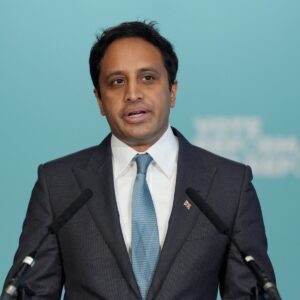
Yusuf Zia, UK Reform Home Affairs Spokesman, appears in Picture @Ghana Chronicles X’s account.


If Ebola Is Too Dangerous for America, It Is Too Dangerous for Kenya

AfCFTA Aims to Unite Africa’s Fragmented Markets Into a Single Trading Bloc
![President Denis Sassou Nguesso casts his vote at a polling station in Brazzaville during the Republic of Congo’s presidential election, 15 March 2026. [Congo Presidency/Handout via Reuters]](https://aukmedia.co.uk/wp-content/uploads/2026/04/DS-80x80.png)
Republic of Congo’s Denis Sassou Nguesso, 83, Secures Fifth Term in Power

Zia Yusuf from Reform UK Proposes Blocking Visas for Citizens of Countries Pursuing Slavery Reparations

ECOWAS at 50: President Obasanjo Warns of Declining Trust and Growing Divisions at Oxford Forum


