
AUK Radio
Inspirational Headteacher, Ian Douglas, Building a Long-Lasting Legacy for Luton Children.
Luton Chiltern Academy, which has more than 1,168 students, is part of Chiltern Learning Trust, a variety of multi-academy for local and national organisations. The Academy, opened in 2018 in temporary accommodation, relocated a year later to a £ 20 million purpose-built school building in Luton Gipsy Lane.
Ian Douglas, headteacher of this outstanding academy is committed to excellent standards of teaching and learning and helping raise the attainment of all local students.

1. What has been your path into your current role?
Upon finishing school, I joined the Army. I left after 5 years, undertaking a range of jobs from welding to van driving, then began coaching swimming; I enjoyed teaching and decided to go back to college for 5 years to become a Newly Qualified Teacher. Immediately, I got on well with pupils and staff, managing to work my way up through a range of leadership positions, spending 16 years at Denbigh High School, transforming it from a challenging to an excellent school. Thereafter, I secured the Headship at Chiltern Academy.
2. Why did you choose the field of education?
Having been involved with the teaching and coaching of swimming, I enjoyed working with young people and realised the impact you can have on a young person’s life and how rewarding it is to see young people learn, develop and grow, turning into mature young adults. Whilst it is a challenging field to work in, in my opinion, it is the most rewarding field. I now have many of my old pupils who are teachers, working with me here at Chiltern Academy. That bond is a lifelong bond.
3. What are your challenges managing Chiltern Academy?
By far, the biggest challenge in education is the recruitment of new teachers into teaching positions. There is a national shortage and we have to work very hard to secure the best teachers, as they have the biggest impact on young people.
4. What are your aspirations, and expectations?
My aspirations are for the children; that they leave us as healthy, successful, well-rounded individuals, who can live comfortable lives and contribute to society. My expectations are that children work hard, and be polite and respectful. My expectation of staff is that they commit fully to our pupils, to ensure they get the best education we can offer.
5. Chiltern Academy was opened in 2018, and your first ever Ofsted report this year was good. Did you expect that?
Our first grading was good with some outstanding features; I did expect this as having worked in an outstanding school, it can take a long time to build traditions, routines, and culture of outstanding practice, and to embed it fully within the school. Ofsted gave a good reflection of our school and a grounding to push forward to be fully outstanding, which I expect us to be. Without GCSE results, it is difficult to secure a fully outstanding judgment, and that was made clear to us when the inspecting team came in.
6. Parents and pupils are proud of your school. What do you do to sustain this reputation?
First and foremost, as I alluded to earlier, it is vital we continue to recruit and retain the best staff possible. Whatever school you work in, children lead similar lives; eating the same foods, listening to music, and wearing similar clothes…however, it is the adults who instill the culture, values, and ethos. Moving forwards as a school, whilst our PSHE is outstanding, there are still areas we need to work on with young people and this is one of the things that makes the school special; where they learn their values and zest for life. Reputations are hard to build but easy to lose. Ours are built on a solid footing of the hard work of staff, buy-in from parents, and the enthusiasm of young people. We need to maintain this as we move forwards.




Africa
Ghana to Introduce Visa-Free Entry for All Africans in Pan-African Push
Ghana is to grant visa-free access to all African nationals, in a move the government says will deepen regional integration and reaffirm the country’s historic role at the centre of Pan-Africanism.
President John Mahama announced the policy during a state visit by Emmerson Mnangagwa, declaring that the measure will take effect on 25 May, the annual commemoration of Africa Day.
The decision positions Ghana among a small but growing group of African states seeking to dismantle long-standing barriers to movement across the continent. Officials in Accra argue that restrictive visa regimes have historically constrained trade, tourism and labour mobility within Africa, despite decades of political commitments to integration.
Under the new framework, travellers will be able to enter Ghana without prior visa approval, with the scheme forming part of a broader digital migration system centred on a forthcoming e-visa platform. Authorities say the reform is intended to streamline border processes while maintaining security oversight.

Visa Free To All Africans
The policy also carries economic intent. Ghanaian officials expect the move to stimulate intra-African commerce and increase visitor flows at a time when many African economies are seeking to diversify growth beyond commodity exports. Tourism, in particular, is likely to be an early beneficiary, as airlines and hospitality operators respond to reduced administrative friction for travellers.
Mahama used the announcement to signal a wider diplomatic effort. He said the government would intensify negotiations on reciprocal visa waiver agreements for Ghanaian citizens, noting that more than 20 such arrangements have been secured over the past year. The objective, he indicated, is to ensure that mobility gains are not one-sided but embedded within a broader framework of continental reciprocity.
The initiative aligns with ambitions underpinning the African Continental Free Trade Area (AfCFTA), which seeks not only to liberalise trade but also to ease the movement of people and services. Analysts caution, however, that implementation will be decisive. Past attempts across the continent have often faltered at the level of border enforcement, infrastructure capacity and inter-agency coordination.
Even so, the symbolism is difficult to ignore. By tying the policy’s launch to Africa Day, Ghana is drawing a direct line between contemporary economic strategy and the ideological legacy of Pan-African unity — a legacy the country has long claimed as part of its political identity.
If effectively executed, the visa-free regime could mark a substantive shift in how African states approach mobility: not as a security risk to be contained, but as an economic asset to be unlocked.
Africa
Ghana Welcomes UN Backing for Slavery Remembrance Day As a Call for Justice and Healing Renewed
Ghana has expressed its “sincere appreciation” to UN member states following the adoption of Resolution A/RES/80/250 on 25 March 2026, which formally recognises the International Day for the Remembrance of the Victims of Slavery and the Transatlantic Slave Trade.
The resolution was approved by 123 countries in the UN General Assembly, with all 15 members of the United Nations Security Council reportedly voting in favour.
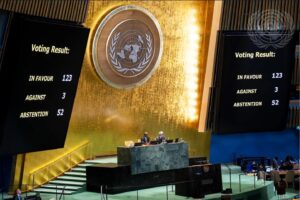
Copyright @nbcnews-The U.N. General Assembly Hall on Wednesday after the vote on a resolution declaring the trafficking of enslaved Africans “the gravest crime against humanity.”Manuel Elías / U.N. Photo
The vote, however, revealed divisions among member states. The United States, Argentina, and Israel voted against the resolution, which explicitly described slavery and the transatlantic slave trade as a “crime against humanity” and called for reparations. All 27 members of the European Union abstained, citing concerns over the language describing slavery as “the gravest crime against humanity.”
Gabriella Michaelidou, the Cypriot deputy UN ambassador whose government currently holds the EU’s six-month presidency, warned that such phrasing could imply “a hierarchy among atrocity crimes,” potentially creating diplomatic sensitivities regarding other human rights violations.
Ghanaian officials framed the adoption as a significant milestone in advancing justice, recognition, and healing for the millions affected by slavery. Discussions following the vote included John Dramani Mahama, emphasising the need for continued dialogue and public awareness around the transatlantic slave trade’s enduring legacy.
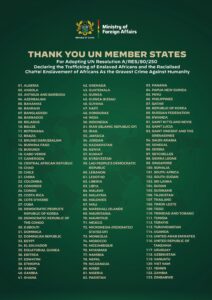
Countries-Adopted-the-Rseolution
The resolution further positions Ghana as a leading voice in global governance, highlighting its democratic credentials and influence in shaping international priorities such as sustainable development and global health.
While the resolution’s adoption is expected to strengthen international observance of the remembrance day and promote educational initiatives, the abstentions and opposing votes underscore ongoing debates over historical accountability, reparations, and the framing of atrocities within the UN system.
Africa
Barbadians launch initiative to support Cubans amid ongoing US blockade.


If Ebola Is Too Dangerous for America, It Is Too Dangerous for Kenya

AfCFTA Aims to Unite Africa’s Fragmented Markets Into a Single Trading Bloc
![President Denis Sassou Nguesso casts his vote at a polling station in Brazzaville during the Republic of Congo’s presidential election, 15 March 2026. [Congo Presidency/Handout via Reuters]](https://aukmedia.co.uk/wp-content/uploads/2026/04/DS-80x80.png)
Republic of Congo’s Denis Sassou Nguesso, 83, Secures Fifth Term in Power

Zia Yusuf from Reform UK Proposes Blocking Visas for Citizens of Countries Pursuing Slavery Reparations

ECOWAS at 50: President Obasanjo Warns of Declining Trust and Growing Divisions at Oxford Forum


