
Black History Month
Four things we learned from Montell Neufville about Luton Youth

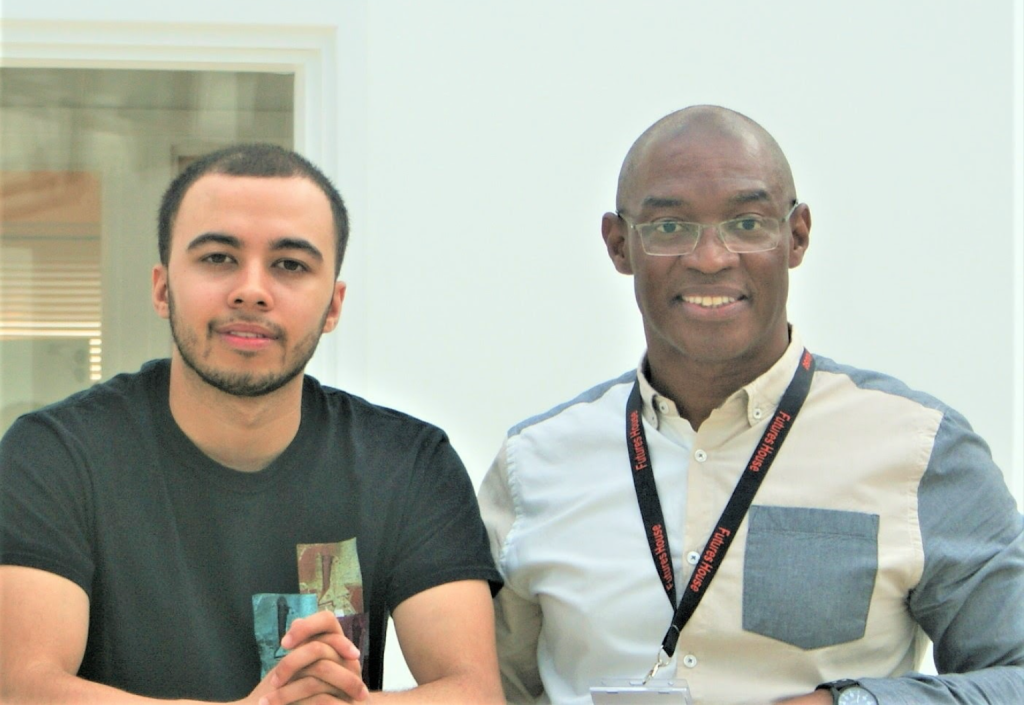
Montell Neufville is a founder of Att10tive and the chair of the Bedfordshire Police Community scrutiny panel that scrutinises Stop and Search and the use of force. This panel is considered to be one of the model scrutiny panels in the UK.
He also chairs a variety of committees and seats on boards including, school governing bodies, council committees, Young enterprise and a New Deal for communities’ regeneration board, as well as chairing a Youth network board.
For the past 10 years, he delivered training workshops to members of the community including young people, and over 100 sessions to police officers.
He is seen as the champion of Luton’s youth excellence.
Since its creation, Att10tive has engaged with over 2000 young people and runs a wide range of workshops from employability skills and anti-bullying, to workshops around knife crime and biases.
Some of the participants have gone on to do senior or prestigious jobs in public service or even opened up their own businesses.
- Can you tell us about Att10ntive? And why?
The name att10tive comes from being attentive, paying attention, and taking notes. Our main aim is active learning, every day is a learning opportunity, the more you pay attention the better. The “10” came from a European workshop. I used to go to many European countries before Brexit to deliver workshops. We found it’s good to have a mix of numbers and letters to make a name unique and memorable. Our participants are anyone who wants to learn and grow. our methods are non-formal education and active learning
- What concern do you have about young people in Luton?
We are not equipping young people to be the best that they can be and to fit into the world that they will inherit. We prepare them for our world and their parents’ world, where there were jobs for life and where you selected what career you wanted to do. The world they will enter is different and the skills are different, young people will need adaptability, creative skills, to use their initiative, flexibility, and good communication skills. Technology is changing very fast and will impact their lives even more than our lives. Ten years ago, there were few mobile phones, in ten years’ time, we will talk to our houses to make everything. So jobs will be different and ways to make money and careers will be different. I find generation Z struggling to engage and speak to each other, much like those people born in the 1960s and 1970s. People born in the 2000s in this Millenium find communicating hard.

- Do you think that Att10ntive will redefine the future of young people in Luton?
We try to redefine young people by equipping them to be the change they want to see in the world. by giving them skills they would not learn in traditional jobs or education and by encouraging them to network and meet influential decision-makers. Our aim is to give them the tools to make a positive difference.
- What do young people really need in Luton?
What else do they need? I would say mentoring, advice and guidance, the ability to solve problems, conflict resolution skills, the ability to integrate and meet people not like them. The ability and opportunity to use their creative skills and passions. The skills to resolve conflicts without resorting to bullying or to carrying weapons.









Africa
Why was Pan-African Activist Kemi Seba Arrested in South Africa?
Africa
South Africa: Julius Malema, Leader of EFF, Sentenced to Five Years in Prison Over Firearm Offence.
A South African court has handed a five-year prison sentence to Julius Malema, in a ruling that could ultimately disqualify one of the country’s most prominent political figures from serving in parliament.
Malema, leader of the Economic Freedom Fighters, remained in court in KuGompo City on Thursday as magistrates weighed whether to admit an appeal against the sentence. It was not immediately clear whether that process would delay any transfer to prison.
The 45-year-old was convicted last year on multiple charges stemming from a 2018 rally in the Eastern Cape, where he fired a rifle into the air inside a stadium. Delivering judgment, magistrate Twanet Olivier warned that impunity for such offences would pose “a serious threat to our democratic state”.
The court imposed five years for unlawful possession of a firearm and a further two years for unlawful possession of ammunition, alongside fines for additional offences, including discharging a firearm in a built-up area. The sentences are to run concurrently.
Under South Africa’s constitution, any prison term exceeding 12 months—once all appeals are exhausted—renders an individual ineligible to serve as a lawmaker. For Malema and his party, the implications are significant.
The EFF, parliament’s fourth-largest party, has built a strong following among younger South Africans disillusioned by the enduring inequalities that have persisted since the end of apartheid in 1994. Its platform—centred on the nationalisation of mines and land redistribution—has made Malema both a galvanising and polarising figure in the country’s political landscape.
Prosecutors argued that failing to impose a custodial sentence would set a dangerous precedent, urging the court to consider the maximum penalty of 15 years. Malema’s legal team, by contrast, maintained that the firearm was discharged as part of a celebratory gesture, with no intent to cause harm, and called for a more lenient sanction, such as a fine.
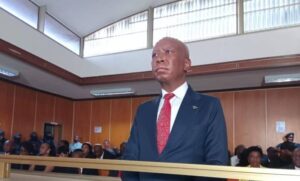
Julius Malema, leader of the Economic Freedom Fighters, during his appearance at the East London Magistrate’s Court on Wednesday. (Source: witness.co.za)
Africa
Benin: Finance Minister Romuald Wadagni Wins Presidency with Landslide Victory
Benin’s finance minister, Romuald Wadagni, has won the country’s presidential election with a commanding 94% of the vote, according to provisional results released by the electoral commission (CENA), after more than 90% of ballots were counted.
The result confirms a widely anticipated victory for Wadagni, 49, who stood as the candidate of the ruling alliance between the Progressive Union Renewal (UPR) and the Republican Bloc (BR). His campaign was strongly backed by outgoing president Patrice Talon, who is constitutionally barred from seeking a third term after completing two five-year mandates.
Wadagni’s ascent caps a decade in which he served as finance minister, overseeing sustained economic growth averaging above 6% annually. He has pledged continuity of that trajectory in a country often cited as one of West Africa’s more stable democracies, despite a failed coup attempt in December 2025.
His only challenger, Paul Hounkpe of the FCBE party, conceded defeat while counting was still under way. In a statement, he extended “republican congratulations” and called for respect for democratic norms.
CENA chair Sacca Lafia said the vote had been conducted peacefully. Civil society observers reported around one hundred incident alerts, including early openings of polling stations and cases where ballot boxes appeared already full at opening time.
The Economic Community of West African States (ECOWAS) observer mission described a “peaceful atmosphere” and “smooth running” of the vote.
About 7.9 million citizens were registered to vote, with turnout recorded at 58.75% nationally. Participation was significantly lower in the capital, Porto-Novo, where it fell to between 20% and 40% in some polling stations.
However, the election took place under conditions criticised by analysts, who argue that political space has narrowed during Talon’s presidency. The main opposition party, Les Démocrates, was excluded from the ballot after failing to secure parliamentary endorsements required under constitutional changes introduced last year.
Those reforms, which tie presidential eligibility to legislative backing, effectively blocked opposition leader Renaud Agbodjo from qualifying for the race, as his party holds no seats in the National Assembly.
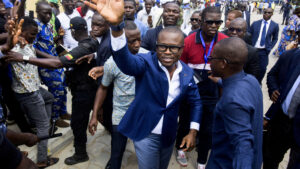
Romuald Wadagni campaigning in Cotonou, Benin, last month. He has been declared the country’s new president according to provisional results. Credit: Charles Placide Tossou/Reuters (via The New York Times)


If Ebola Is Too Dangerous for America, It Is Too Dangerous for Kenya

AfCFTA Aims to Unite Africa’s Fragmented Markets Into a Single Trading Bloc
![President Denis Sassou Nguesso casts his vote at a polling station in Brazzaville during the Republic of Congo’s presidential election, 15 March 2026. [Congo Presidency/Handout via Reuters]](https://aukmedia.co.uk/wp-content/uploads/2026/04/DS-80x80.png)
Republic of Congo’s Denis Sassou Nguesso, 83, Secures Fifth Term in Power

Zia Yusuf from Reform UK Proposes Blocking Visas for Citizens of Countries Pursuing Slavery Reparations

ECOWAS at 50: President Obasanjo Warns of Declining Trust and Growing Divisions at Oxford Forum


